

Google Business Profile Help says eligible merchants can ask AI to suggest a description from profile information and sources such as the business website. The page had no publication date when checked on September 2, 2026, and Google still tells the merchant to review the result for accuracy.
Last verified: September 2, 2026.
Google's profile guidelines say:
Use the business description field to provide useful information on services and products offered, as well as the mission and history of your business.
Description approval
Use AI for the draft, not the facts
- 01Source
Freeze the branch fact sheet
Services, history, credentials, hours, page, and owner
- 02Draft
Generate one candidate
Treat every new phrase as a claim to check
- 03Review
Approve sentence by sentence
Reject promotions, links, invention, and cross-branch leakage
- 04Verify
Publish narrowly and read back
Change only the description, then inspect Search and Maps
Google Business Profile Help: Manage your Business Profile description and representation guidelines; checked September 2, 2026.
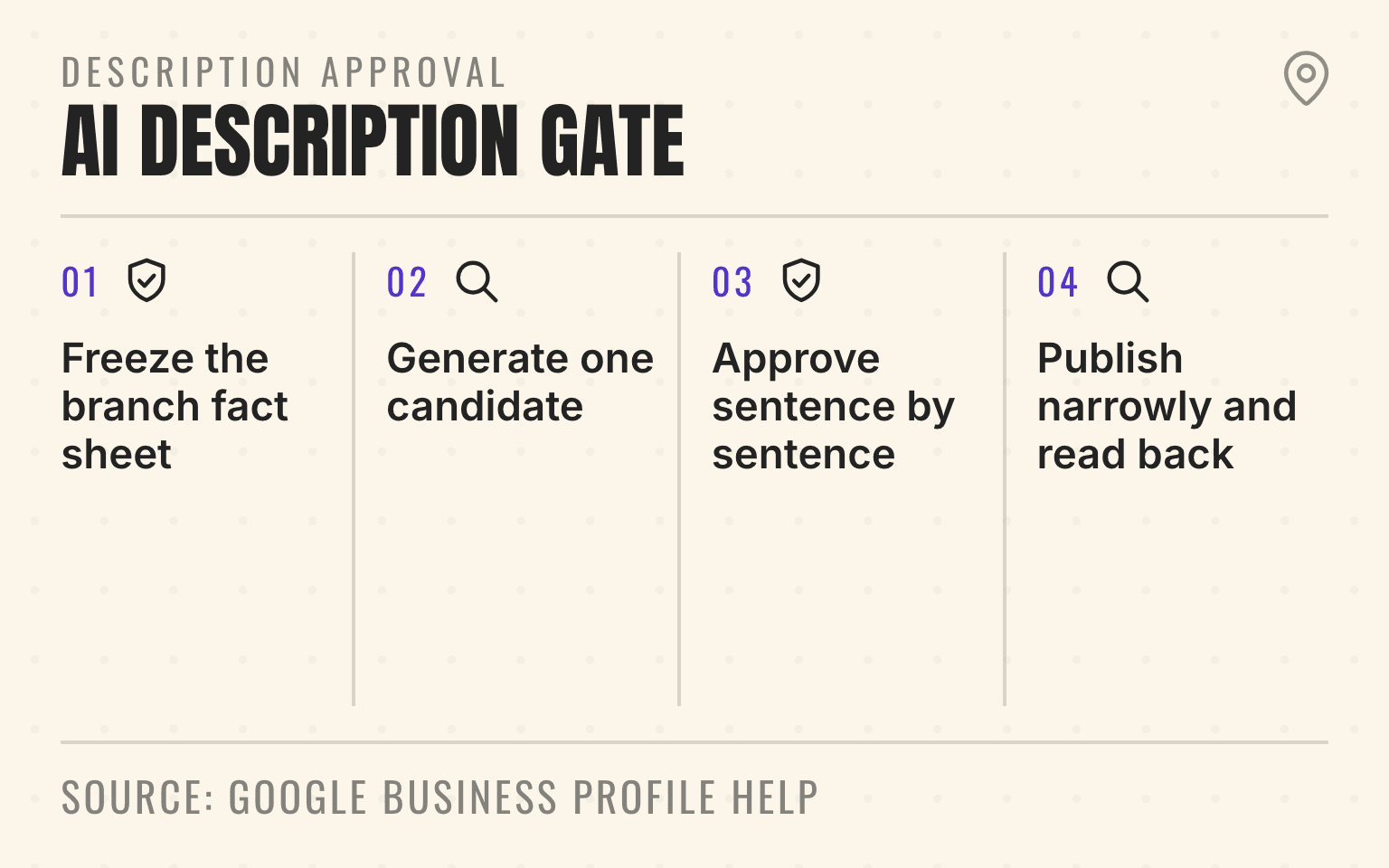
- Four-step approval flow for AI-suggested Google Business Profile descriptions.
- 1. Freeze the branch fact sheet: Services, history, credentials, hours, page, and owner
- 2. Generate one candidate: Treat every new phrase as a claim to check
- 3. Approve sentence by sentence: Reject promotions, links, invention, and cross-branch leakage
- 4. Publish narrowly and read back: Change only the description, then inspect Search and Maps
The useful part is real: Google now lets eligible merchants use AI to suggest a Business Profile description. Google says the tool can draw from the profile and other sources such as the business website. It also calls the output creative text and tells the merchant to review it for accuracy.
That last instruction should define the workflow. A multi-location company has more ways for a fluent paragraph to be wrong. One branch may not install the equipment another branch services. A med spa may offer a treatment at six clinics but not the seventh. A restoration group may have one location with 24-hour dispatch and another with an answering service that books the next morning.
Important
Use Google's AI suggestion as a draft, not as the branch source of truth. The location owner should approve every factual claim before anyone saves it.
If you want to see whether current branch facts already agree across Google, owned pages, and AI answers, start with the Cheers AI Visibility Grader. The description review is one control inside that larger source system.
What Google's description tool actually does
Google's Business Profile Help says a merchant can write a description or ask AI to suggest one. The suggestion may use information from the Business Profile and other sources, including the website. A merchant can start from a blank field, provide an existing description, try another result, edit the suggestion, and then save it.
The feature is available only in select regions and languages, requires the user to be at least 18, and is subject to Google's generative AI prohibited use policy. Availability therefore should not be treated as a portfolio-wide entitlement. Some location owners may see the control while others do not.
Google does not say that an AI-generated description improves rankings. Its Business Profile guidelines describe the field as a place for useful information about services, products, mission, and history. Google Search Central separately tells site owners that its AI search features rely on established Search practices and up-to-date Business Profile information. Neither source turns the description generator into a ranking shortcut.
The operating question is not whether AI can write the paragraph. It is whether the inputs and review process can keep 20, 80, or 300 public location records accurate.
Build a branch fact sheet before generating copy
Start with the facts a regional operator can verify. For each location, record the real-world business name, primary service model, services actually performed, customer-facing area, qualifications that apply there, approved history, and the owned page supporting those statements. Add an owner and a last-checked date.
This record prevents a common failure: corporate copy becomes local fact without a local check. An HVAC parent company may install geothermal systems in Denver but service conventional heat pumps only in Colorado Springs. The national website can mention both. The Colorado Springs description should not.
A med spa group has the same problem with devices, practitioner credentials, and treatment availability. A clinic should not inherit a laser service because the brand offers it somewhere else. The equipment, licensed provider, booking path, and clinic page should support the claim at that location.
Use the location-level Business Profile services guide to settle service truth before describing it. If the service list and branch page disagree, the description generator is exposing an upstream governance problem, not solving one.
Review every sentence against Google's profile rules
Google says a Business Profile description should be honest, relevant, useful, and connected to the business. It also names three specific description problems: low-quality or distracting content, a focus on promotions or prices, and links.
An AI draft can violate those rules without looking obviously broken. "Best emergency plumber in Phoenix, now 20% off" sounds like ordinary marketing copy. It combines an unverified superlative, an availability claim, and a promotion. A generated link or phone number belongs in the proper profile field, not in the description.
Read each sentence as a claim that needs an owner. "Family-owned since 1987" needs a history source that applies after acquisitions and rebrands. "Licensed and insured" needs current, location-relevant evidence. "Open 24/7" needs a customer route that a caller can actually use at 2 a.m. "Serving the entire metro" needs a real dispatch boundary, not a growth target.
Google's generative AI use policy also prohibits using its AI tools for deceptive or misleading practices. A review process should catch ordinary profile-policy problems before they become a broader misrepresentation issue.
Separate brand language from branch truth
A controlled description has two layers. The brand layer covers stable facts such as the company's mission, operating approach, or history. The branch layer covers the services, market, operating model, and proof that change by location.
For a roofing rollup, "residential and commercial roofing" may be safe corporate language only if every location handles both. If two branches do commercial flat roofs and the rest do residential replacements, the service claim belongs in the branch layer. The same rule applies to emergency restoration, pest types, electrical licenses, med spa treatments, hospitality amenities, and manufacturer authorizations.
Do not manufacture uniqueness by swapping city names or adjectives. A description is not better because every branch has different prose. It is better when every meaningful difference is true, customer-relevant, and supported by the location record.
This is why Google Business Profile alone is not enough for AI visibility. The description should agree with the branch page, services, reviews, citations, and actual customer route. Copy cannot compensate for a fragmented local entity.
Next step
Is AI recommending your business?
Find out how visible you are across ChatGPT, Gemini, Perplexity, and AI Overviews.
Use AI for variation, not invention
Once the fact sheet is approved, give the generator a bounded draft. Start with the stable brand sentence and the verified branch facts. Ask for a suggestion, then compare every new phrase with the source record.
The most useful AI contribution is phrasing. It may make a stiff internal description clearer, shorten repetition, or surface a customer-friendly way to explain a service model. The merchant's contribution is judgment. The operator decides whether "emergency," "certified," "same-day," "full-service," or a named treatment is accurate at that location.
Keep rejected phrases in the review record. If the same unsupported claim appears across several suggestions, trace the source. A stale corporate service page, inherited profile category, or copied branch page may be feeding the generator. Correcting that source is more valuable than deleting the phrase one profile at a time.
Put API updates behind the same approval gate
Google's Business Information API represents each managed location as a Location resource. Its profile field describes the business in the merchant's own voice. The patch method requires an update mask for field-specific changes and offers a validate-only option that checks a request without changing the location.
Those controls are useful for multi-location work, but they do not approve the copy. An API client can make a precise change to the wrong description just as efficiently as it can publish the right one.
Store the location identifier, proposed description, source record, reviewer, approval time, request result, and public readback in one change record. Patch only the description field. Use validation where the integration supports the workflow. Publish a small batch, wait for the result, and inspect the public profile before scaling.
The multi-location Business Profile update workflow covers the wider change-control system. It matters here because Google says profile edits usually appear quickly but can sometimes take much longer. A successful request is not the same as a verified public result.
Run a 10-location pilot before portfolio rollout
Choose locations that expose real variation: a large branch, a small branch, a service-area business, a storefront, an acquired brand, a market with different services, and at least one location whose existing description is already accurate.
For each pilot location:
- Freeze an approved fact sheet and capture the current public description.
- Generate or revise one candidate, then mark every sentence as brand fact, branch fact, or unsupported.
- Send branch facts to the local operator and policy-sensitive claims to the appropriate legal, clinical, or licensing owner.
- Publish only approved copy, then read it back in Google Search and Maps.
- Record corrections, approval time, public match, and any source that produced a recurring error.
The control group is the location with an already accurate description. If the AI version adds no customer value, leave the existing copy alone. The presence of a generation button is not a reason to rewrite a good field.
Measure approval rate, unsupported-claim rate, minutes to approval, public-match rate, and corrections after publication. Do not call ranking movement an AI-description win. Too many other profile, page, review, competitive, and search-demand variables change at the same time.
A practical 14-day operating plan
Days 1-3: settle the source record
Inventory descriptions and assign one operator to each location. Classify shared and local facts. Fix service, history, credential, availability, and website discrepancies before generating new prose.
Days 4-7: draft and review the pilot
Generate one candidate for each pilot location. Keep the original, suggestion, edits, and approval in the change record. Reject any sentence that cannot be traced to a current source or confirmed by the branch.
Days 8-10: publish narrowly
Update only the approved description field. Use a small batch, verify request results, and avoid unrelated profile edits. If Google rejects or changes the content, record the exact field and status before trying again.
Days 11-14: read back and decide
Inspect Search and Maps, test any service or availability claim against the customer route, and calculate the pilot's correction rate. Roll out only if the workflow produces more accurate, useful copy without creating an approval backlog.
The description is a controlled claim set
Google's AI suggestion can save drafting time. It cannot determine which branch performs which work, whether a credential is current, whether an acquired location shares the parent company's history, or whether a 24-hour claim survives a real phone test.
The durable system is simple: verified branch facts, a bounded draft, accountable review, a narrow update, and public readback. If those controls are missing, keep the current accurate description or write one manually. Faster copy is valuable only when the location remains true.
Sources
- Manage your Business Profile description, Google Business Profile Help, no publication date. Checked September 2, 2026.
- Guidelines for representing your business on Google, Google Business Profile Help, no publication date. Checked September 2, 2026.
- Location resource, Google Business Profile API, November 2025. Checked September 2, 2026.
- locations.patch, Google Business Profile API, November 2025. Checked September 2, 2026.
- Generative AI prohibited use policy, Google, January 2025. Checked September 2, 2026.
- AI features and your website, Google Search Central, May 2025. Checked September 2, 2026.
Dylan Allen-Arnegård is the CEO & Co-Founder of Cheers, the local search platform for multi-location service businesses.