

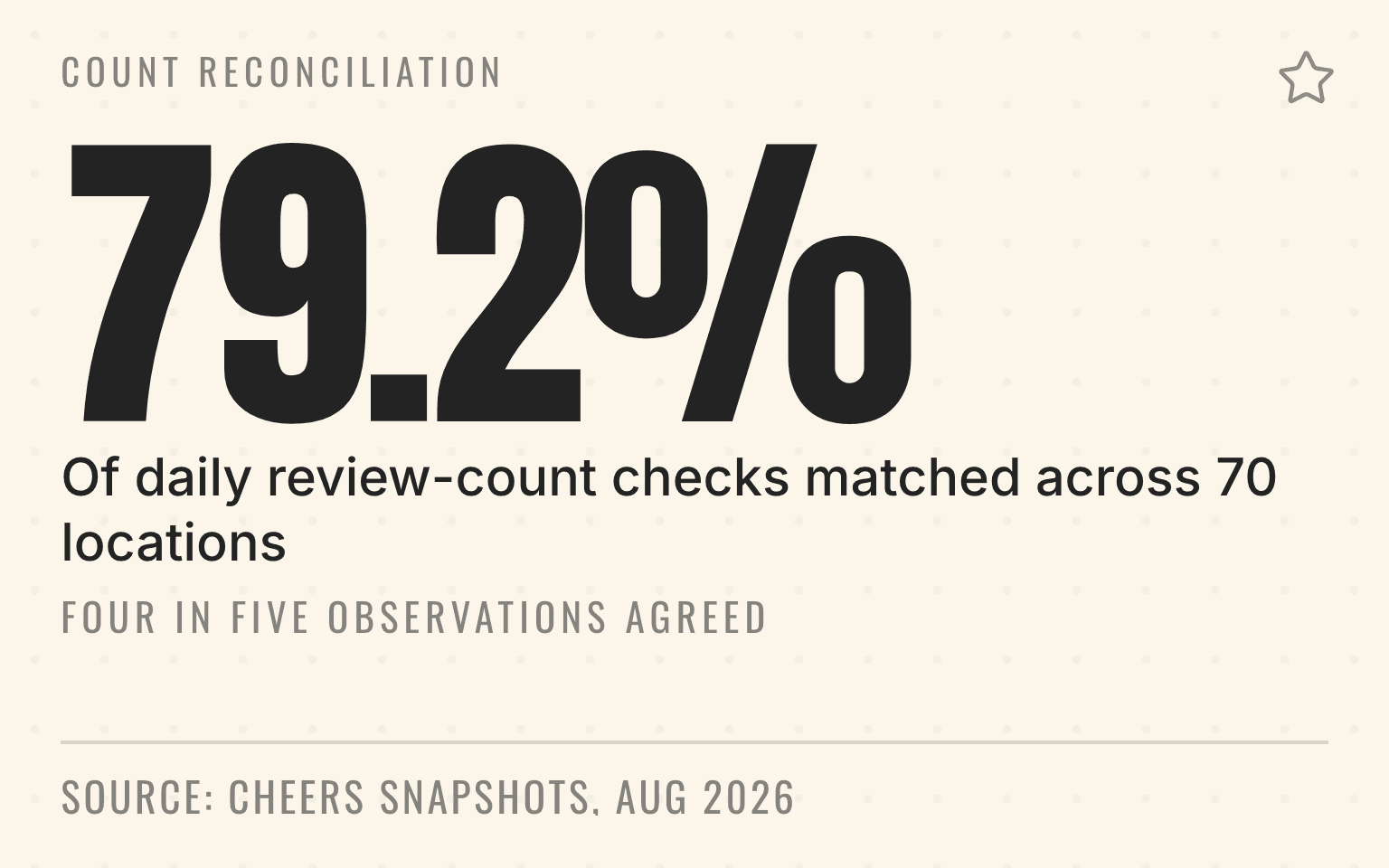
Cheers compared two internal review-count sources every day across 70 home-services locations in 11 organizations, from July 7 through August 17, 2026. The two counts agreed in 79.2% of 2,657 comparable observations, and 56 of the 70 locations disagreed at least once. A review-count mismatch is ordinary. Treating every one as a deleted review is what turns a monitoring signal into a support ticket nobody can close.
Last verified: September 2, 2026.
Google says the first cause outright:
"Reviews are checked to ensure they comply with our policies. In some cases, this process might take a few days."
And it is equally direct about the case that has no remedy: "Reviews removed for policy violations won't be restored."
Google may delay a review while its systems check it, remove it for a policy violation, transfer it after a Business Profile move or merger, or disable reviews temporarily on a profile. A separate fake-engagement enforcement action can pause new reviews or unpublish existing ones. Those cases can look alike from a count alone, but they require different responses.
Important
A review-count mismatch is a monitoring signal, not proof that Google deleted a review or that an internal system failed. Verify the same profile, surface, and time before assigning a cause.
For a multi-location home-service brand, the useful question is not simply, "Where did the review go?" It is: which public record changed, what evidence separates the possible causes, and who owns the next check? The Cheers review-generation system helps connect each location's review activity to an accountable operating record. The reconciliation method below explains how to keep that record honest.
A missing review is a symptom, not a diagnosis
Start by naming what is actually missing. Operators often collapse four different incidents into one phrase:
- One contribution is not visible: a customer says a specific review was submitted, but the team cannot find it on the expected profile
- The visible total changed: the public review count dropped or differs from a stored observation
- Reviews moved with the profile: the business moved, merged profiles, reopened, or was reinstated, and review transfer is incomplete
- The profile cannot receive reviews: Google sent a restriction notice, displays a warning, or has temporarily disabled new contributions
A publication delay doesn't justify a restriction appeal. If the profile merged, check its history before blaming the integration; while Google may still be checking the first contribution, don't ask the customer to post it again.
Google's missing or delayed reviews guidance says its systems may take time to publish a review while checking it. Google doesn't restore reviews it removes for policy violations, and a profile merger can take several days to finish transferring reviews. If reviews remain missing after a profile reinstatement, Google directs the business to contact support.
That is enough to establish the first operating rule: classify before escalating.
Next step
Is AI recommending your business?
Find out how visible you are across ChatGPT, Gemini, Perplexity, and AI Overviews.
Verify the same profile and the same surface
A portfolio can have a Business Profile ID, Place ID, Maps URL, Search knowledge panel, Reviews API resource, internal branch ID, and vendor record for the same location. Names are not stable keys. An acquired HVAC company may still have an old listing, a duplicate at the former address, and a new service-area profile with similar display names.
Record the Business Profile ID, Place ID, canonical customer-facing Maps URL, internal branch ID, visible count, surface, observation time, and last known count. Save a screenshot only as supporting evidence. The identifiers and timestamp make the observation comparable.
Then look at the profile from the same public surface. A signed-in manager view, Google Search panel, Maps result, API response, and third-party cache do not necessarily refresh together. If the team compares Monday's Maps count with Sunday's warehouse count, the mismatch may be timing rather than loss.
Profile history matters. Ask whether the branch recently moved, changed from a storefront to a service-area business, merged a duplicate, reopened, or recovered from suspension. Google's review-transfer guidance explains when reviews can move with a profile. The Business Profile address-change guide covers the location controls that should be preserved during a move.
The field record cannot prove that a customer submitted compliant content, but it can establish that the service event and branch assignment are real. That distinction keeps the team from treating a customer claim as platform proof or dismissing it without investigation.
What Cheers review-count snapshots show
Cheers compared two internal review-count sources across a home-services segment from July 7 through August 17, 2026. The publishable aggregate covered 70 locations across 11 organizations and 2,657 comparable daily observations. The two counts matched in 79.2% of those observations.
Most locations still showed a difference at least once: 56 of 70. The median location's largest observed absolute difference was two reviews. The 90th percentile was 8.4 reviews. Differences ran in both directions, with one source higher at some locations and the other higher at others.
Those numbers don't measure deleted reviews. The dataset repeats daily observations, so they don't represent independent incidents. Collection timing, refresh timing, profile identity, or source scope can make the two counts differ. The public analysis contains no raw customer review, organization name, prompt, contact detail, or row identifier.
The practical finding is narrower: an occasional count mismatch is common enough that it should enter a reconciliation queue before it becomes an executive conclusion. The size, persistence, direction, and profile history determine whether the signal deserves escalation.
Classify the incident before choosing a Google path
Publication delay
If one customer says a review is missing but the profile remains active and other reviews can publish, allow time for Google's checks. Capture the customer's submission date and the intended profile link if the customer volunteers them. Do not ask for the review text, account credentials, or a second post as the first response.
Profile move, merger, or reinstatement
If the location changed address, merged duplicates, or returned after suspension, compare the old and current profile identifiers. Review transfer can take several days. If reviews remain missing after reinstatement, follow Google's support route with the profile history and evidence. The multi-location access standard helps ensure the person escalating has authority over the correct profile.
Content-policy removal
Google's Maps user-contributed content policy requires contributions to reflect a genuine experience and prohibits fake engagement, rating manipulation, off-topic content, harassment, personal information, and other restricted material. Google doesn't restore content it removes for a policy violation. A completed service event alone can't prove that the contribution followed the policy.
Business-level review restriction
A restriction is a separate incident. Google's April 2026 Maps protections update says a sudden suspicious review spike can lead Google to remove fake content, temporarily pause new reviews, alert the owner, and display a banner. The same post reports the scale behind those systems: "Our advanced systems and expert analysts blocked or removed over 292 million policy-violating reviews, while publishing more than 1 billion helpful reviews" during 2025. If the profile has an owner notice or cannot receive contributions, use the review-restriction recovery plan. Preserve the request workflow before changing it.
Internal retrieval or reconciliation gap
If the public profile is stable but an internal count differs, inspect the integration. Google's reviews list method returns reviews for a verified location and includes totalReviewCount and averageRating. Verify the location resource, pagination, job completion, query time, and stored timestamp. The multi-location Reviews API guide covers the wider retrieval and readback workflow.
Build one review-count reconciliation queue
The queue can live in a database or spreadsheet. It needs enough structure to keep 70 branch questions from becoming 70 unrelated support tickets:
- Identity and observation: branch ID, Business Profile ID, Place ID, canonical Maps URL, surface, visible total, stored total, prior total, and timestamps
- Scope and history: one contribution or total count, recent move or merger, reinstatement, duplicate cleanup, and any owner notice or public warning
- Classification: pending check, publication delay, transfer, suspected policy removal, restriction, internal sync issue, or unresolved
- Ownership and next action: location operator, portfolio owner, integration owner, next check date, support case, evidence attached, and final readback
Set thresholds by portfolio risk rather than one universal number. A persistent one-review gap after a profile merger may matter more than a same-day two-review difference during a busy campaign. A 20-review drop across several branches sharing one collection workflow deserves a different owner from a single customer complaint.
Close the incident only when the public state and operating record agree or the record explains why they do not. "Support contacted" is an activity. It is not a resolved review state.
Escalate with evidence, not a replacement campaign
Google Business Profile support can investigate an eligible profile problem. Give the support team a compact packet: profile identifiers, customer-facing URL, screenshots with timestamps, prior and current counts, move or reinstatement history, owner notice, and a description of the exact missing state. Keep private customer and service details out unless Google specifically requests them through an authorized channel.
Don't start a replacement-review campaign while the cause remains unresolved. A broad request blast can't restore a policy-removed review or finish a profile transfer. If Google has paused new contributions, another request sends customers into a broken path; when the first review is merely delayed, a repost may create duplicate feedback.
The branch can still improve the customer experience. It can confirm the work, explain the next step, and provide a neutral review link after the incident is understood. Google's review management guidance allows businesses to share review links and reminds them that public replies should protect customer privacy.
Run a 14-day operating rhythm
Day zero: preserve and classify
Capture the exact profile and surface, current and prior counts, incident scope, owner notices, and recent profile changes. Pause only the affected or shared workflow when there is evidence of a restriction or policy risk. Do not erase the configuration that may explain the incident.
Days one through five: recheck the public state
Observe the same surface at a consistent time. Compare direction and persistence instead of relying on the absolute count alone. Confirm that the profile can receive other reviews. If a merger or reinstatement is involved, keep the case in transfer status while the documented waiting period remains plausible.
Days six through fourteen: escalate or close
Open the appropriate support or appeal route only when the classification and evidence support it. For an internal mismatch, repair the location mapping or retrieval job and rerun the same record. Close with the final public count, disposition, readback time, and any workflow correction.
Leadership should see three separate numbers: open signals, classified incidents, and resolved cases. Reporting every temporary mismatch as a deleted review overstates the problem. Reporting only the current total hides recurring operational drift.
Methodology and limits
The Cheers analysis used read-only aggregate queries against daily review-count snapshots for home-service organizations. The period ran from July 7 through August 17, 2026. The segment included 11 organizations, 70 location-level organizations, and 2,657 observations where both count sources were available, exceeding the minimum public threshold of 10 organizations and 100 observations.
The analysis counted matches, the number of locations with any mismatch, direction of differences, and each location's maximum absolute difference. It did not inspect raw reviews or diagnose why a difference occurred. Repeated daily observations are correlated. Results describe this segment and period, not every Google Business Profile or review system.
Sources
- About missing or delayed reviews. Google Business Profile Help, undated help page. Review checks, policy removals, profile mergers, temporary contribution limits, reinstatement, and support. Checked September 2, 2026.
- Move reviews across Business Profiles. Google Business Profile Help, undated help page. Review-transfer eligibility and profile-move behavior. Checked September 2, 2026.
- Prohibited and restricted content. Google Maps contribution policy, undated policy page. Genuine experience, fake engagement, rating manipulation, and personal information. Checked September 2, 2026.
- Business Profile APIs: list reviews. Google, reference last updated 2026. Verified-location retrieval, pagination, average rating, and total review count. Checked September 2, 2026.
- New ways we are protecting businesses on Maps. Google, April 2026, reporting calendar-year 2025 enforcement volumes. Checked September 2, 2026.
- Manage customer reviews. Google Business Profile Help, undated help page. Checked September 2, 2026.
- Home Services AI Visibility Index 2026. Cheers Research, September 2, 2026. Panel-wide review volume and response rates for the same segment.
Dylan Allen-Arnegård is the CEO & Co-Founder of Cheers, the local search platform for multi-location service businesses.