


Bing's Topics Portfolio can show questions where other sites get cited and yours does not. Microsoft introduced the beta on October 13, 2026. For a multi-location service brand, the useful decision is which existing page needs a better answer, and whether the branch can deliver the service behind that answer.
I would start with one query and one page. A broad topic is too loose an assignment: an editor can write a perfectly readable article that sends a customer toward work the local branch does not do.
Last verified: October 31, 2026.
Read the question behind the topic
Open AI Performance in Bing Webmaster Tools, then Topics Portfolio. The tab requires sufficient data. Its topics group grounding queries, and opportunity queries identify places where other sites appear. Classification can be imperfect; branded queries can also turn up as opportunities.
The topic measures describe different units. Topic Size estimates citations across all sites in the topic and period. Sites Cited estimates distinct sites; Queries estimates distinct grounding queries. They are approximate planning signals, and opportunity citation volumes appear as ranges.
The miniature below makes the difference visible. Its fictional topic has three citations: Site One appears for Query A and Query B, while Site Two appears for Query A. That gives three citations, two sites and two distinct queries. Repeated citations do not create additional sites.
How the counts differ · Fictional miniature
One topic, three denominators
Topic: drain inspection
Query A
Camera inspection before repair
Query B
Recurring drain blockage
- 3
- Topic Size
- citations
- 2
- Sites Cited
- unique sites
- 2
- Queries
- distinct queries
Bing Topics Portfolio, Oct 13, 2026; checked Oct 31. Example invented to explain the units.
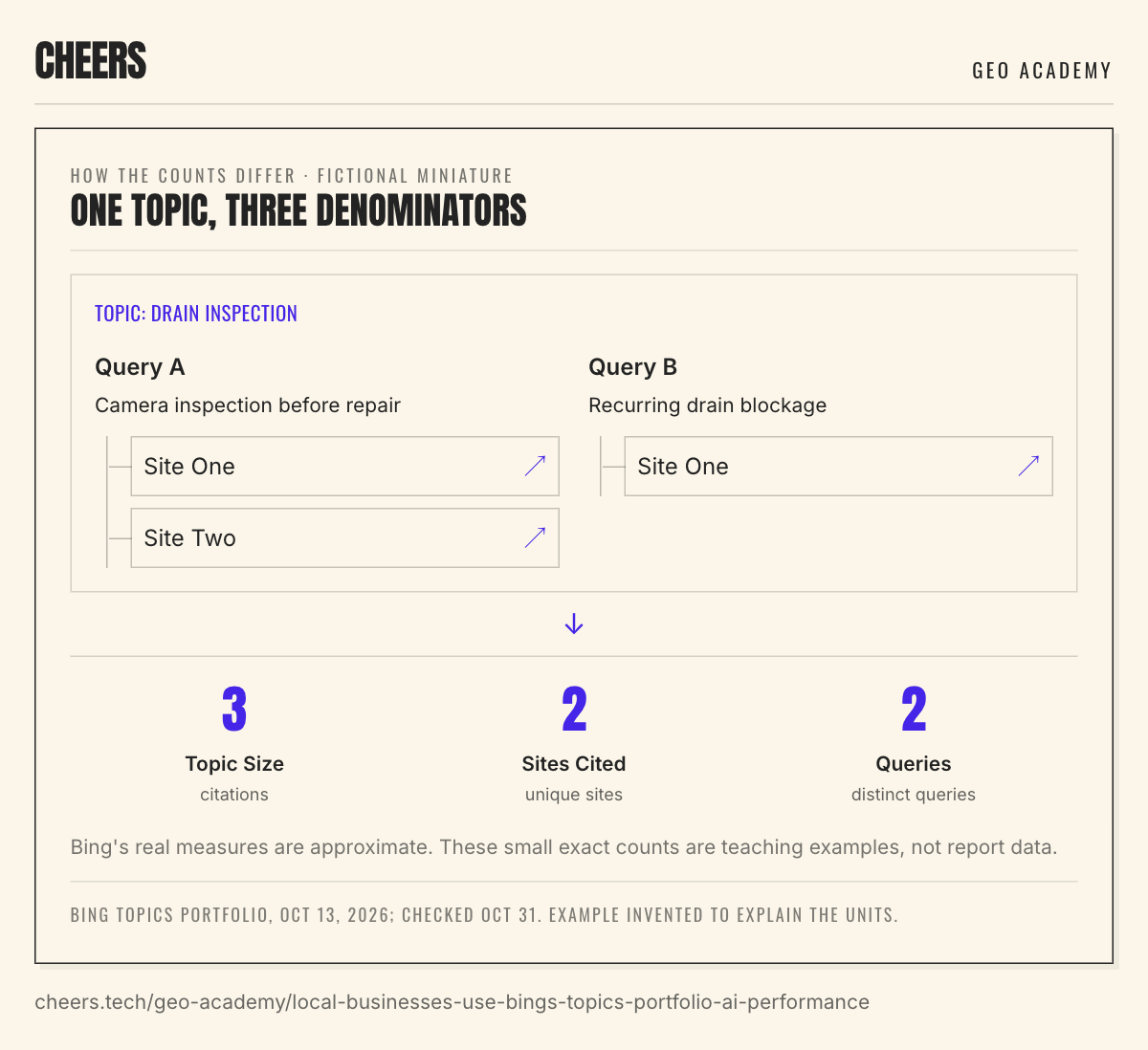
Read the actual opportunity query before weighing its size. A large plumbing topic might contain residential drain work, commercial pumping and equipment sales. Your branch's service list is a better filter than the theme's label.
Work one opportunity all the way through
Consider a fictional Mesa plumbing branch that performs residential drain cleaning and camera inspections. Its existing page, /mesa/drain-cleaning/, already explains the service area and has a booking link. It says nothing about camera inspection.
An illustrative opportunity query is "drain camera inspection before repair in Mesa." The customer needs to know whether this branch offers inspection and how to arrange it. Sending that customer to a water-heater article would not answer the question. Creating a second Mesa drain page would give the team another URL to maintain without resolving why the first page is incomplete.
The assignment is to improve the existing drain-cleaning page. Ask the branch manager whether camera inspection is offered, which situations it suits, and how customers request it. The editor should not infer availability, diagnostic certainty or a price from the query.
For this example, assume the manager confirms that inspections are available for recurring blockages and that customers should ask when booking. The repair can be direct:
Our Mesa team offers camera inspection for recurring drain blockages. Ask about an inspection when booking; the technician will confirm whether it suits your line.
Place that answer near the service explanation and make the booking link reach the Mesa branch. The new wording gives the customer a next step while leaving the inspection decision with the technician. The location-page guide covers the other information that destination should contain.
Fictional plumbing assignment
Turn a query into a page repair
Opportunity query
“Drain camera inspection before repair in Mesa”
Existing answer owner
/mesa/drain-cleaning/
Right service and branch. Missing: when a camera is used and how to request it.
Repair, after branch confirmation
“Our Mesa team offers camera inspection for recurring drain blockages. Ask about an inspection when booking; the technician will confirm whether it suits your line.”
Booking link → Mesa branch
Rejected opportunity
“Commercial grease-trap pumping in Mesa”
Outside this branch's services → no assignment
Cheers worked example, Oct 31, 2026. Query and business facts are fictional; not a Bing capture.
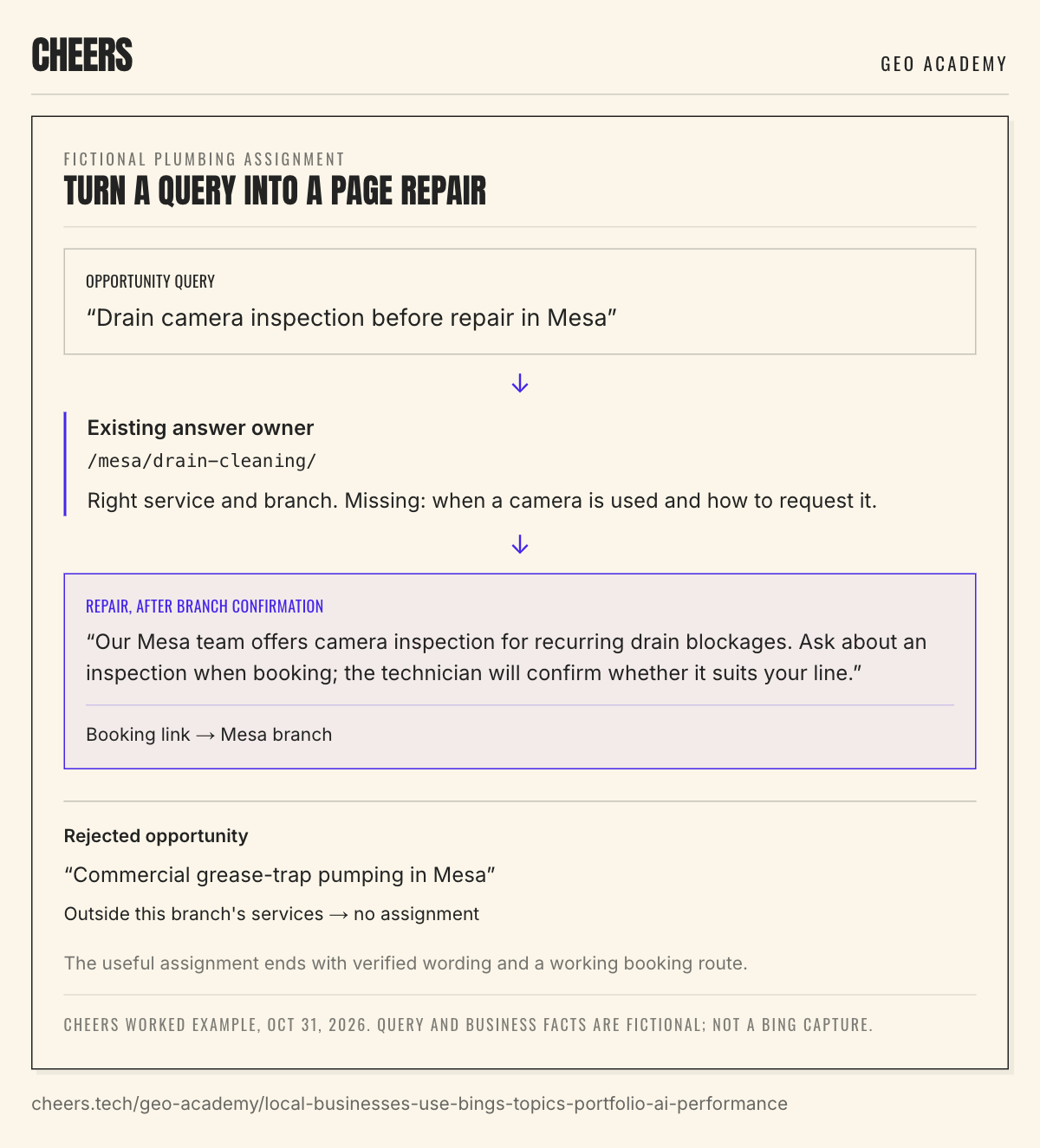
The diagram also rejects "commercial grease-trap pumping in Mesa." This fictional branch does not provide that service. A large citation range would not make it a useful assignment. The right output is a short rejection reason, rather than a new page promising work the branch cannot take.
Decide whether a new page is actually needed
An existing service page should carry a service-selection question when the answer belongs there. A separate guide earns its own URL when the customer has a distinct question that needs more explanation.
For example, the branch's drain-cleaning page can explain that camera inspection is available. A guide could explain what an inspection can and cannot establish before a homeowner approves repair work. Those are different reading tasks. Link the guide back to the relevant service page so the customer can act after reading it.
Before commissioning either, search your own site. Read the pages that already discuss the question, including older acquired-brand content. If two pages make different promises about the same branch, settle the service facts before adding another answer. A content gap may be a missing sentence, a misplaced answer or a disagreement between pages.
If Topics Portfolio is absent, treat the report as unavailable. It does not establish zero AI visibility. You can still assign a useful repair from a repeated customer question that a branch manager can verify.
Separate citations, visits and booked work
Microsoft's AI Performance documentation describes citations across Copilot, Bing AI summaries and selected partner integrations. Grounding queries are sampled retrieval phrases; page citation counts do not show ranking or placement in an answer.
After the repair, compare the same topic and page over equal-length periods. Save the edit date so the comparison has a clear starting point. A change in citation activity is useful evidence, but seasonality, other page changes and changing questions can also affect the result.
Use website analytics for visits to that landing page, then branch records for qualified enquiries and bookings. Keep those observations separate. A customer may read a cited answer without visiting, and an enquiry may arrive without enough information to identify its source. The AI traffic measurement guide explains how to connect the records when attribution is available.
Hand the editor a finished assignment
A useful brief should let the editor start without guessing what the business sells. For the Mesa example, it would contain:
- The query and the existing drain-cleaning URL, with the report period attached.
- The missing camera-inspection answer and the branch manager's confirmed service limits.
- The approved wording, the Mesa booking destination and a date to review the result.
Complete the page repair this week, then inspect the published page on a phone and follow its booking route. If the copy is accurate but the form still reaches the wrong branch, the assignment is unfinished.
Sources
- Introducing Topics Portfolio (Beta) in AI Performance. Microsoft Bing, October 13, 2026. Feature, measures and beta limitations.
- Introducing AI Performance in Bing Webmaster Tools Public Preview. Microsoft Bing, February 10, 2026. Supported surfaces and citation scope.
The plumbing query, branch, page paths and proposed copy are fictional teaching examples. They are not a captured Bing report or a customer result. Both sources checked October 31, 2026.
Dylan Allen-Arnegård is the CEO & Co-Founder of Cheers, the local search platform for multi-location service businesses.