


Ordinary service and location pages are outside Google's Indexing API scope. The quickstart, updated October 16, 2026, limits it to pages with JobPosting or BroadcastEvent embedded in VideoObject. If a vendor proposes using it to submit your branch pages, ask them to explain the page's eligibility before discussing request volume.
For those branch pages, Google recommends URL Inspection for a few URLs and a sitemap for a larger batch. A quota allowance doesn't change which submission method fits the page.
Last verified October 31, 2026.
Choose the route by page purpose
A plumbing company can publish a drain-cleaning page and an individual technician vacancy on the same website. They need different treatment. The service page follows ordinary website discovery. The vacancy may qualify for the Indexing API if its content and markup meet Google's job-posting requirements.
A general careers directory isn't the same as a page for one genuine vacancy. Adding JobPosting markup to a branch landing page doesn't turn it into a job posting. Start with what the page actually contains.
Google submission decision
Page type comes before API quota
Service · branch · ordinary page
Use standard discovery
- A few URLs
- URL Inspection
- Many URLs
- Sitemap
Supported page types only
Check Indexing API eligibility
Individual JobPosting
BroadcastEvent within VideoObject
Google Indexing API Quickstart and recrawl guidance. Verified October 31, 2026. Eligibility never guarantees indexing.
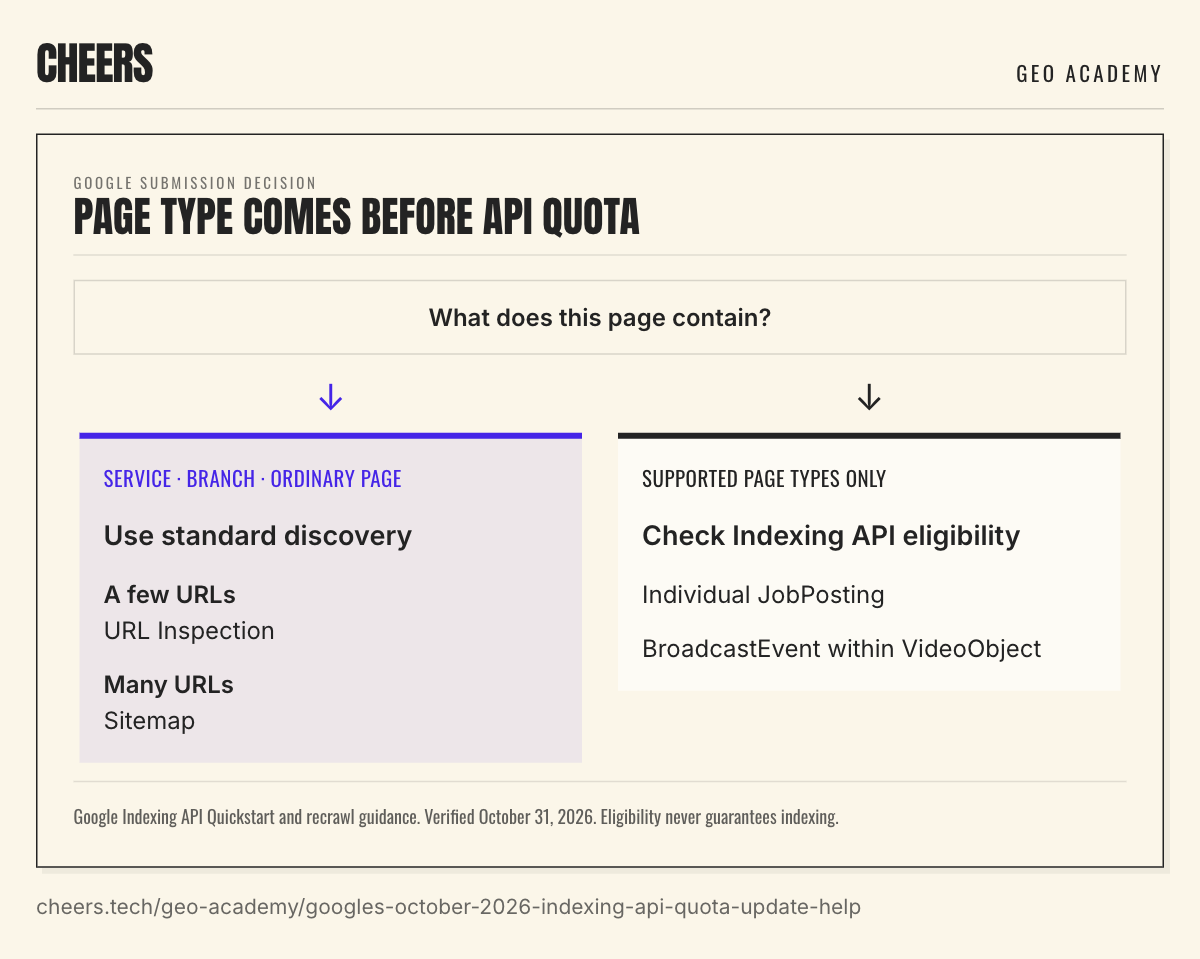
That distinction is useful during an acquisition or website launch, when one supplier may be handling both recruitment and customer acquisition. Ask for a page-type column in the proposed submission list. It should be clear which pages the Indexing API supports and which belong in the normal sitemap and Search Console workflow.
For customer-facing pages, check the location information before requesting a recrawl. The branch needs an accurate service area and a working contact route regardless of how Google discovers it.
A few changed pages: use URL Inspection
For a new branch page, inspect its final public address in the correct Search Console property. Google's recrawl guide requires owner or full-user access to request indexing through the tool.
Read the indexed result, then use a live test when checking the current page. A useful example is a branch page that still carries the noindex setting from its preview. The live test can help identify that problem. Fix the page before requesting another crawl.
The indexed result and live test answer different questions. Google's help page explains that the live test checks whether the page might be indexable; the indexed view describes Google's stored version. A live pass doesn't mean Google has already indexed the change.
There is also a URL Inspection API. Its inspect method reads indexed-version information. It doesn't offer the Search Console interface's Request Indexing action. If a supplier says it is using an inspection API, ask whether the report describes a status check or an actual recrawl request.
A larger batch: keep the sitemap accurate
Google's recrawl guide recommends a sitemap when many URLs need discovery. For a group opening several branches, check that the sitemap lists the final public pages and that the site links to them. Don't use a whole-site resubmission to avoid investigating a broken template.
For example, a redesigned roofing site might list the new branch URLs while its navigation still points through old redirects. Correct the links and check the final destinations. If the project includes renamed pages, follow the URL migration checks alongside the sitemap work.
Keep one list of the pages that materially changed. For each, record the final URL, the change, any defect found and the next action. A missing inspection result should remain unknown until someone can check it. There is no useful reason to turn it into either a success or a failure by assumption.
What the October quota update says
Google's October 16 changelog says the quota page was updated to describe current limits and process, and to remove an outdated form. It doesn't say that ordinary business pages became eligible or that the published allowance was newly introduced.
The quota page lists a default of 200 publish requests per project per day, counting both update and deletion notifications. It resets at midnight Pacific Time. The allowance belongs to the project, not each branch. Developers should check the project's actual quota in Google API Console.
Those details matter for a genuine eligible-page workflow. They don't justify moving service pages into it. Google's quickstart also warns against using multiple accounts or other methods to exceed quotas.
Read the report without upgrading the claim
Google's Indexing API guide says HTTP 200 means it may try to recrawl an eligible URL soon. The metadata endpoint reports notification history, not when the URL was indexed. A report should name the observation it actually has.
Keep the report precise
A receipt is one kind of evidence
Indexing API HTTP 200
Notification accepted. May prompt a recrawl.
Notification accepted
May prompt a recrawl
URL Inspection live test
Current page checked. Not an indexed-version check.
Current page checked
Not an indexed-version check
URL Inspection indexed view
Stored index information. Read crawl and canonical details.
Stored index information
Read crawl and canonical details
Save the tool, URL and observation time. Update the claim only when the evidence changes.
Google: Using the Indexing API; URL Inspection help. Verified October 31, 2026. Labels are Cheers reporting guidance.
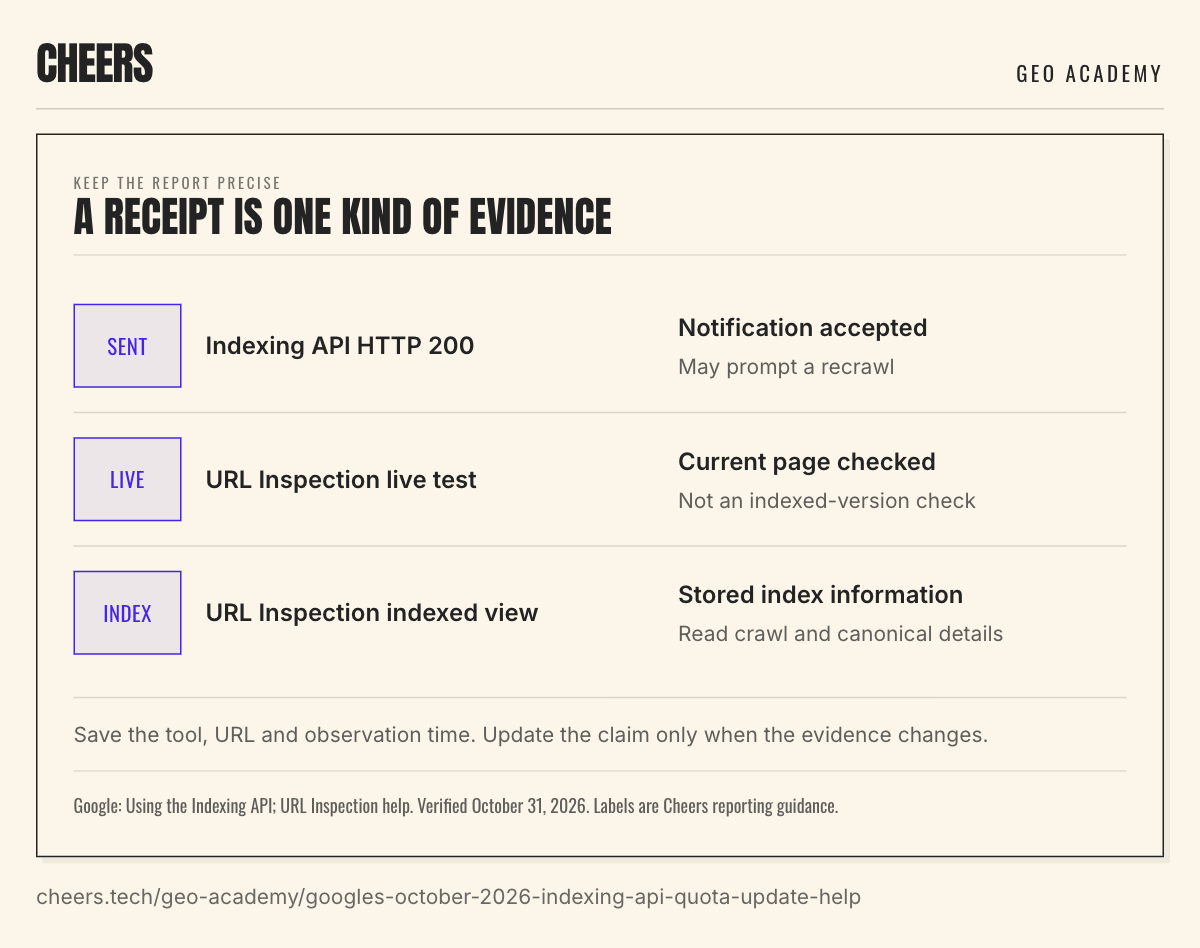
Keep the report small: which URL was checked, which tool was used, what it returned and when. If a later inspection shows the intended page indexed, add that observation. Repeated requests for the same URL don't speed crawling, according to Google's recrawl guidance.
This week, review the next changed-page batch with the website owner. Separate genuine vacancies from branch and service pages, fix the page defects, then use the supported discovery method. Your AI-search traffic report can track subsequent visits and enquiries without treating submission totals as business results.
Sources
- Indexing API Quickstart. Supported page types and quota-abuse warning; updated October 16, 2026.
- Ask Google to recrawl your URLs. Individual requests, sitemaps and repeated requests.
- URL Inspection tool and index.inspect API. Live tests versus indexed information.
- Quota and pricing and documentation updates. October 16 quota documentation change.
- Using the Indexing API. HTTP 200 and notification metadata.
Sources read October 31, 2026. Workflow examples are illustrative, not results from a customer submission.
Dylan Allen-Arnegård is the CEO & Co-Founder of Cheers, the local search platform for multi-location service businesses.