

Across the 13 home-services companies in the Cheers panel, over the 28 days ending September 2, 2026, leaving out questions that name the company itself, Gemini named the tracked business in 23.7% of checks on average and cited it as a source in 10.8%. Being named and being cited are not the same event, and neither is a ranking. An HVAC brand can appear when a customer asks Gemini for an AC company in Phoenix and disappear when the same question goes through Google Maps, while a med spa surfaces for one neighborhood and routes the customer to the wrong location. Calling all of that a "Gemini ranking" hides the first question an operator needs to answer, which is which product made the recommendation.
Cheers panel, Gemini only
Mentioned, rarely linked
23.7%
Mean company share of Gemini checks that named the tracked business
10.8%
Checks that cited the business as a source
21.3%
Median company appearance rate
244,098
Gemini checks in the window
Cheers panel, 28 days ending September 2, 2026: 13 home-services companies, non-branded prompts, aggregate only, Gemini checks only (corrected September 28, 2026). Method at cheers.tech/research/methodology.
| Finding | Value | Base |
|---|---|---|
| Mean company share of Gemini checks that named the tracked business | 23.7% | Stated in the source |
| Checks that cited the business as a source | 10.8% | Stated in the source |
| Median company appearance rate | 21.3% | Stated in the source |
| Gemini checks in the window | 244,098 | Stated in the source |
The short answer is that there is no single switch that gets a business recommended everywhere Gemini appears. Make every location accurate in Google Maps and Business Profile, publish useful local evidence on the website, correct meaningful public-source conflicts, and test the exact customer surface by market.
Important
There is no documented universal "Gemini local ranking." Gemini Apps, Ask Maps, Google AI Search, and developer apps using Maps grounding are different surfaces with overlapping but not identical inputs.
The broader guide to earning AI business recommendations covers the cross-provider foundation. This guide isolates Google's Gemini-branded and Gemini-powered local experiences so a multi-location operator can assign the right fix.
Gemini is not one local recommendation surface
Four products matter to a local visibility audit.
Gemini Apps can help a user find places and get directions. Google's Gemini Apps guidance lists what the app can pull for a place:
Get addresses, descriptions, websites, ratings, and opening hours for a place
Every one of those fields is something a location owner controls in Google Maps and Business Profile. With permission, the app can also use the device's location.
Ask Maps is the conversational experience inside Google Maps. Google says Ask Maps uses information from Maps, including places, reviews, photos, and other online information, to answer detailed local questions and make personalized recommendations. It is a Maps product, not simply another label for the Gemini app.
Google AI Search includes AI Overviews and AI Mode. Google's Search Central guidance for AI features says the normal Search foundations still apply and that local business details from Business Profile can be visible in AI responses. Don't use one Search answer as evidence about every response in Gemini Apps.
Maps-grounded developer apps require a developer to configure the Gemini API tool explicitly. Google's Maps grounding documentation describes it as a connection: "Grounding with Google Maps connects the generative capabilities of Gemini with the rich, factual, and up-to-date data of Google Maps." That proves an application can use Maps grounding. It does not expose the selection logic inside consumer Gemini products.
Start by naming the surface behind the miss. The Cheers AI Visibility Grader provides a business-level starting point, but a portfolio still needs a separate readout for every location, market, prompt, and product.
Next step
Is AI recommending your business?
Find out how visible you are across ChatGPT, Gemini, Perplexity, and AI Overviews.
What Gemini can read about a local business
Start with the public facts Google names. In Gemini Apps, that includes the business address, description, website, ratings, and hours from Maps. Google Business Profile guidance also tells businesses to use a real-world name, choose accurate categories, maintain the address or service area, publish correct hours, and use a phone number and website tied to the individual location.
That sounds basic until an acquisition portfolio is involved. The parent website may call a branch "North Valley Heating & Air," Maps may still show the acquired trade name, and the call-tracking page may route to a regional queue. A Phoenix page may promise 24-hour repair while the profile closes at 5 PM. Those conflicts make the branch harder for a person or retrieval system to resolve.
Google's Business Profile representation guidelines also say categories can be detected from a business's website and mentions across the web. The practical response is not to repeat a category phrase everywhere. It is to make the location's real services, geography, hours, qualifications, and customer route consistent enough to verify.
Connecting a Business Profile to Gemini is a separate capability. Google's June 2026 announcement says an owner can connect a profile to Gemini to help review performance, draft review replies, and create updates. Google does not describe that connection as a recommendation enrollment or ranking boost.
What the Cheers source snapshot shows
A first-party Cheers aggregate reinforces the need to inspect more than one public source type. For the week starting August 10, 2026, the Gemini source rollup contained 257,251 source observations across 2,444 cited domains for 41 active home-services brand accounts.
The qualifying public examples were not one uniform list. They included owned brand and manufacturer sites, along with directory, reputation, community, and information sources such as Angi, HomeAdvisor, BBB, ConsumerAffairs, Expertise.com, Reddit, and Thumbtack. For this article, a domain was eligible as an example only when it appeared across at least 10 organizations and at least 100 source observations.
That snapshot does not expose a ranking formula. A source observation is a repeated citation record, not a unique customer, prompt, lead, or vote. The aggregate can show source diversity across a sufficiently broad home-services segment. It cannot tell an operator that adding one directory listing will cause Gemini to recommend a branch.
The useful move is to inspect which owned and third-party sources appear for the queries that matter, then decide whether each source is accurate, relevant, and maintainable.
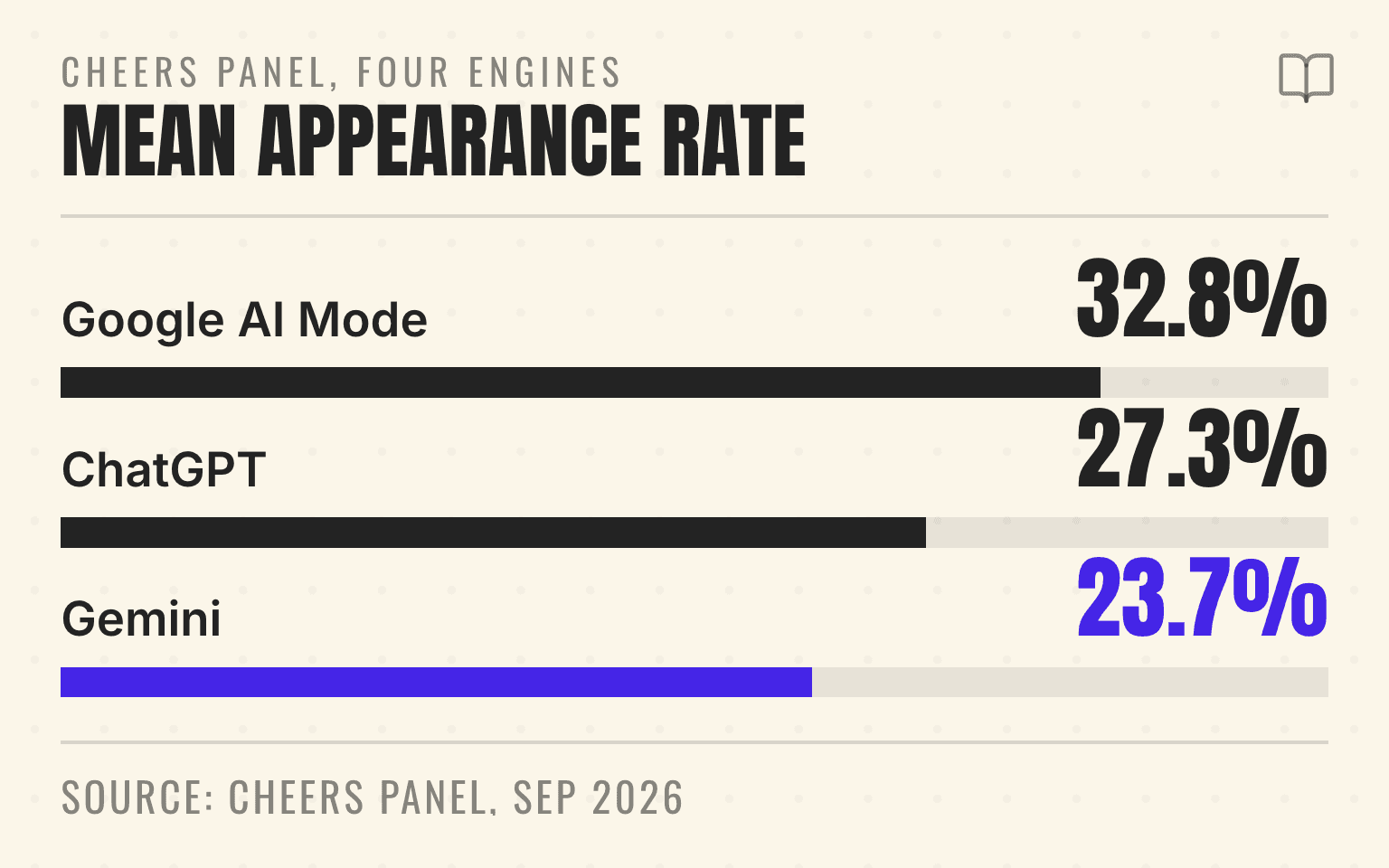
The wider Cheers panel puts a number on how uneven this is by engine. Over the 28 days ending September 2, 2026, across 13 home-services companies, aggregate only, Gemini named the tracked business in 23.7% of checks on average against 32.8% for Google AI Mode, yet Gemini cited that business as a source in only 10.8% of checks against 31.0% for Google AI Mode. Gemini talks about local businesses more often than it links to them. Across 244,098 Gemini checks, the median company was named in 21.3%. For comparison, ChatGPT named the tracked business in 27.3% of checks and cited it in 11.5%, while Perplexity named it in 16.2% and cited it in 23.4%. The cuts and definitions are published in the Cheers Research methodology and the AI visibility statistics.
Build proof beyond Business Profile
Business Profile is a strong local entity record, but it is not the whole evidence system. The Business Profile and AI visibility guide explains where the profile stops. For this Gemini-specific audit, check four layers together.
First, verify the Maps and Business Profile facts for each branch. Second, make the linked location page useful on its own: name the actual services, service area, hours, qualifications, contact route, and firsthand local proof. Third, earn policy-compliant reviews that describe real work without scripts or incentives. Fourth, correct material discrepancies on the public sources customers and AI answers actually surface.
The standard is consistency with reality, not identical wording. A roofing location page can explain storm inspection coverage in detail while Maps uses a concise category and service-area record. Both should resolve to the same operating branch.
This is also why national template work has limits. A 60-location plumbing group can share editorial standards, but its branch pages should not claim the same licensing, emergency coverage, financing, or technician proof when those facts vary. The evidence must remain attributable to the location that will answer the phone and do the work.
Test every market on the surface the customer used
A useful Gemini visibility test is a controlled customer journey, not a single screenshot. Build a small prompt set around high-value services and markets, then preserve the conditions behind every result.
- Fix the commercial question: Use the same service, urgency, customer constraint, and city for each comparison.
- Name the product: Record Gemini Apps, Ask Maps, Google AI Mode, AI Overview, or the specific Maps-grounded application.
- Document context: Save the date, location permission, explicit market, account state, conversation state, and repeated runs.
- Capture the answer: Record named businesses, the correct branch, visible sources or related links, and the reason language the product used.
- Verify the handoff: Check whether the website, call, booking, or directions route reaches a team that can fulfill the promise.
Location and session context can change the retrieval job. Use the location-control protocol for AI search before comparing two markets. Then use the multi-location AI visibility audit to separate portfolio, market, branch, prompt, competitor, and source views.
Google's Gemini sources guidance adds a reporting limit worth writing into the test protocol:
Not all responses include related links or sources. If you don't have the Sources button below a response, Gemini Apps didn't provide any links for that particular response.
An absent Sources button is therefore evidence about the interface, not evidence that no source was used. Store the interface labels accurately instead of calling every visible link a citation.
A 30-day Gemini operating plan
Week 1: Establish the branch record
Choose two priority services in two markets. Verify the Business Profile, Maps result, location page, phone or booking route, hours, categories, and service-area language for every relevant branch. Record discrepancies before editing them.
Week 2: Map public evidence
Run the fixed prompt cells across Gemini Apps, Ask Maps, and the Google AI Search surfaces customers use. Save visible sources, related links, named competitors, branch selection, and customer routes. Classify each source as owned, profile, review, directory, editorial, community, or other public evidence.
Week 3: Repair one bounded gap
Give each correction to the team that controls the source. Marketing owns a thin location page; operations owns corrections to hours or service coverage. Route a broken review-request workflow to the reputation lead and broken calls or bookings to whoever owns customer routing. Change one thing at a time, or the next result won't tell you what mattered.
Week 4: Retest and read back
First confirm that the public change appears, then repeat the original prompt set under the same recorded conditions. Keep the verified business fact separate from the AI observation. You can verify that the Dallas branch hours now match across Maps and the location page; seeing the branch appear in two of three dated Ask Maps runs remains an observation, not access to Google's internal ranking logic.
What Gemini visibility work cannot prove
Google does not publish a minimum review count, directory quota, schema recipe, posting frequency, or guaranteed timetable for a Gemini local recommendation. Treat any fixed threshold as a hypothesis unless the provider documents it.
An answer can also vary because the product, market, personalization, retrieved sources, or model changed. A newly corrected page followed by a better answer is encouraging, but sequence alone does not prove causation.
The defensible goal is more operational: make the right branch easy to identify, support its real service claims with public evidence, observe the surfaces customers use, and keep an auditable record of the next fix. That process can improve local readiness without pretending Gemini is one leaderboard.
Sources
Every link below was opened and checked September 2, 2026.
- Find places and get directions in Gemini Apps. Gemini Apps Help, checked September 2026. Source of the quoted list of place fields the app can return and of the optional device-location behavior.
- Use Ask Maps to get recommendations. Google Maps Help, checked September 2026. Source of Ask Maps product behavior, personalization, and local recommendation guidance.
- Ask Maps and immersive navigation. The Keyword, Google, checked September 2026. Source of the Maps places, reviews, contributor content, and online information used in conversational recommendations.
- Optimizing your website for generative AI features. Google Search Central, last updated July 2026. Source of the Search foundations and of Business Profile details appearing in AI search responses.
- Grounding with Google Maps. Google AI for Developers, checked September 2026. Source of the quoted description of developer-configured Maps grounding.
- Guidelines for representing your business on Google. Google Business Profile Help, checked September 2026. Source of the location-level identity, category, hours, service-area, phone, and website rules.
- Gemini tools for small businesses. The Keyword, Google, June 2026. Source of the Business Profile connection for owner management tasks, which is separate from recommendation eligibility.
- View related sources from Gemini Apps. Gemini Apps Help, checked September 2026. Source of the quoted limit on when a Sources button appears.
- Cheers Research methodology and AI visibility statistics. Cheers panel, 28 days ending September 2, 2026, 13 home-services companies, non-branded prompts, aggregate only (corrected September 28, 2026). Source of the per-engine appearance and citation rates quoted above.
Methodology
The Cheers aggregate uses a read-only weekly source rollup for the week starting August 10, 2026. It includes 41 active home-services brand accounts, 257,251 Gemini source observations, and 2,444 cited domains. Public domain examples required at least 10 organizations and 100 observations. No raw prompts, customer names, row identifiers, private URLs, or individual records were used. Counts describe repeated source observations in this bounded segment and should not be read as unique people, leads, or ranking weights.
Dylan Allen-Arnegård is the CEO of Cheers, the local search platform for service businesses.