


A noindex rule can keep a quote page out of Google, but anyone with the link can still open it. Google's content-sharing guidance, updated October 21, 2026, makes that distinction explicit. If your estimates contain customer addresses, property photos or financing details, a search setting alone leaves the underlying exposure in place.
The useful first step is to separate pages by purpose. A public price guide helps someone decide whether to call. An estimate prepared for one household belongs to that customer. Your website and quoting software should treat those pages differently, even if they share a domain.
Last verified October 31, 2026.
Start with a real route list
Ask the website owner and quoting vendor for the URLs their systems create. Include the page a customer opens, the PDF download and any image links. A protected screen can still offer a download that opens without the same access check.
Use invented customer details for the test. In the fictional roofing example below, /quotes/demo-estimate contains a household's address and roof photos; /files/demo-estimate.pdf is its downloadable copy. Both need access protection. The public /roof-replacement-cost page answers a general pricing question and should remain available for discovery. A nonsensitive /tools/roof-size/sample link can stay available to anyone with the link while being excluded from Search.
Fictional roofing site · route audit
Access first. Search settings second.
Household estimate
/quotes/demo-estimate
Access:Customer only
Search:Keep private
Estimate download
/files/demo-estimate.pdf
Access:Customer only
Search:Keep private
Nonsensitive result
/tools/roof-size/sample
Access:Anyone with link
Search:Crawlable noindex
Public price guide
/roof-replacement-cost
Access:Everyone
Search:Allow discovery
Noindex does not check who is allowed to open a link.
Google: Control what you share; noindex guidance. Verified October 31, 2026. Fictional paths; Cheers recommendations.
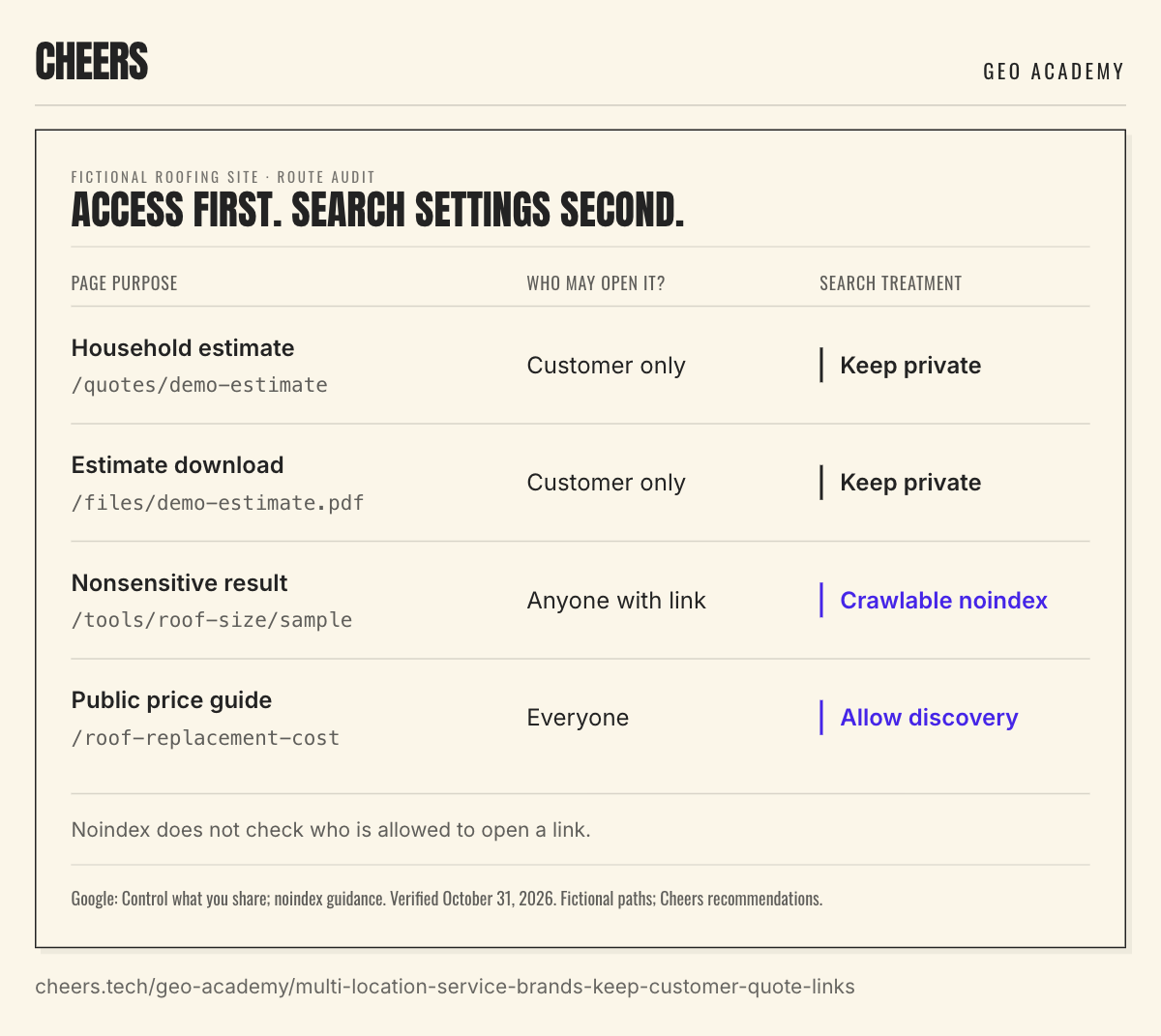
These paths are examples, not findings about a customer site. Build the same matrix with your actual route families, then assign an owner to each decision. Check the information on public location pages separately so an estimate cleanup doesn't hide the pages people need to choose a branch.
Protect private details at the source
For a customer-specific estimate, have the vendor demonstrate how it decides who may view the record. Google recommends password protection for confidential material. The application may use an authenticated customer account or another access mechanism appropriate to the service; the vendor should explain what happens when a link is forwarded, expires or is revoked.
A long, unfamiliar address isn't proof of authorization. Test the page in a signed-out browser and under a different test customer. The question is whether the system denies the wrong viewer, not whether the URL is easy to guess.
Don't make private information public so a crawler can read a noindex tag. Keep the access restriction in place and handle any existing Search result separately. Apply the same checks to the PDF and photo URLs, including old versions that remain reachable after the estimate changes.
This is also a useful boundary for automated appointment and CRM workflows. Permission to create or send a customer link should come with a clear rule for who can use it.
Use noindex for nonsensitive share pages
A public calculator result with no personal information may have a different purpose. If anyone may open it but it doesn't belong in Search, a noindex meta tag or response header is appropriate. Google's noindex documentation says Googlebot must be able to fetch the page and read that rule.
Blocking that same page in robots.txt can prevent Google from seeing its noindex instruction. For a PDF, the site can return an X-Robots-Tag response header. Ask the developer to inspect the actual response, rather than assume the page template covers every file type.
Keep the two decisions visible in the handoff: who may open the resource, and whether it should appear in Search. Our crawler-control guide explains why rules for fetching a page need to be checked by crawler and purpose.
If a quote already appears in Search
Restrict or remove the sensitive content first. Then use Search Console's Removals tool when a result needs to disappear quickly. Google says a temporary removal lasts about six months; it doesn't remove the underlying page from the internet.
Scope the request carefully. An exact URL and a whole prefix have different effects. If public pricing pages and private quotes share a directory, a broad prefix removal could hide useful public pages too. Review the matching routes before submitting it.
When a private quote is already indexed
A temporary removal needs a lasting fix
1. Protect the source
Restrict access or remove sensitive content.
2. Hide the Search result
Review the exact URL or prefix before removal.
3. Verify both journeys
Check authorized access and Search separately.
Temporary Search removal
About
6 months
The underlying page still needs protection.
Google Search Console Removals help, verified October 31, 2026. Sequence: Cheers recommendation.
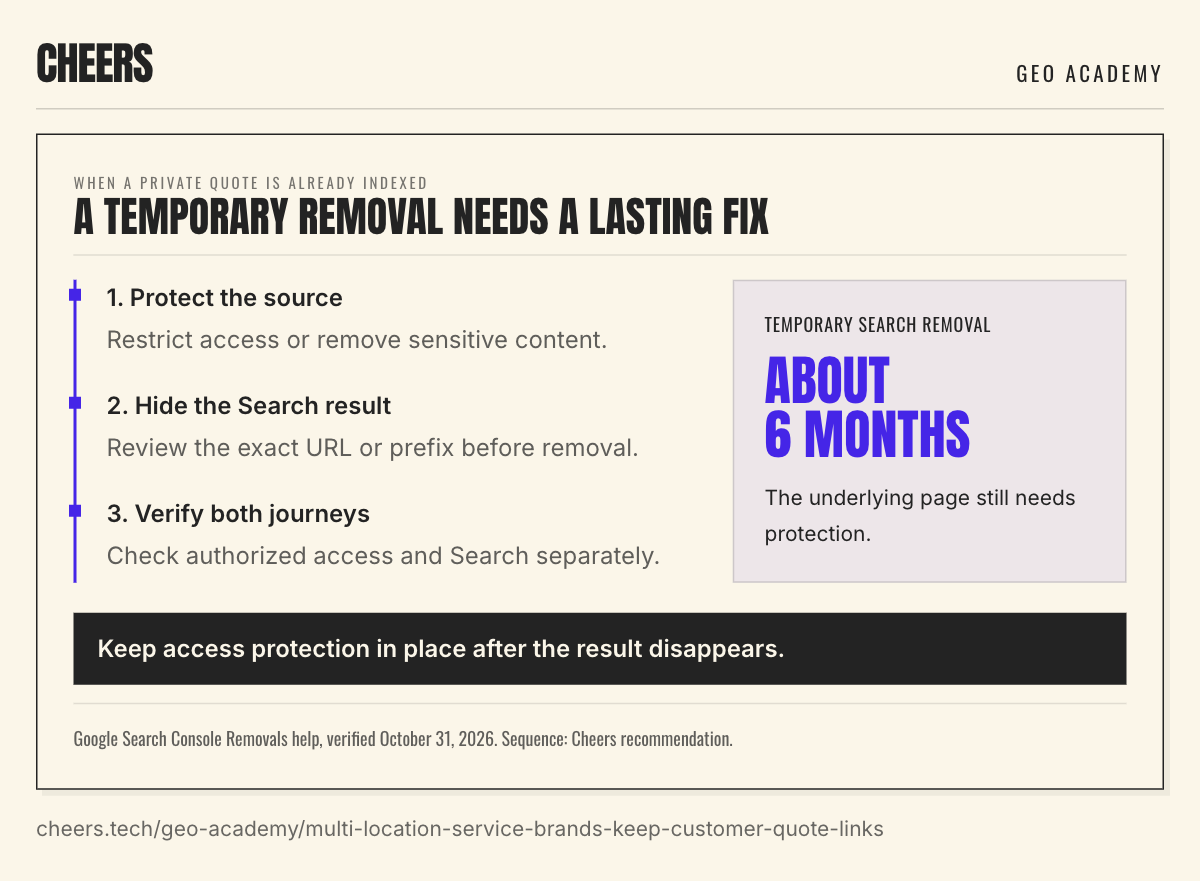
Keep the protection in place after the result disappears. The lasting fix is the site's access restriction, content removal or appropriate noindex rule for a nonsensitive resource. A temporary Search removal buys time for that fix to take effect.
Verify customer access as well. The intended customer should still be able to review their estimate, and a stranger should not see the private details. Record the Search outcome separately from those access tests; one doesn't establish the other.
What the October guidance changes
Google's October 26 documentation update added guidance about link-shared pages and abuse monitoring. Its spam-prevention guide asks platforms to decide which user-created pages are meant for Search. That is a useful prompt to inspect quote tools, but it doesn't make every estimate page a new ranking-policy violation.
This week, have the quoting vendor walk through one test estimate from creation to download and expiration. Ask for the route matrix, evidence of the access checks, and the owner of any Search cleanup. The audit is complete when the team can explain every customer-facing URL and demonstrate that its intended audience can use it.
Sources
- Control what you share with Google Search. Password protection and the limits of noindex; updated October 21, 2026.
- Block Search indexing with noindex. Crawl access, meta tags and response headers.
- Removals tool. Temporary removal duration, URL scope and permanent site changes.
- Search Central documentation updates and user-generated spam prevention. October 26 link-sharing guidance.
Sources read October 31, 2026. Route examples and the audit sequence are Cheers recommendations, not customer findings.
Dylan Allen-Arnegård is the CEO & Co-Founder of Cheers, the local search platform for multi-location service businesses.