

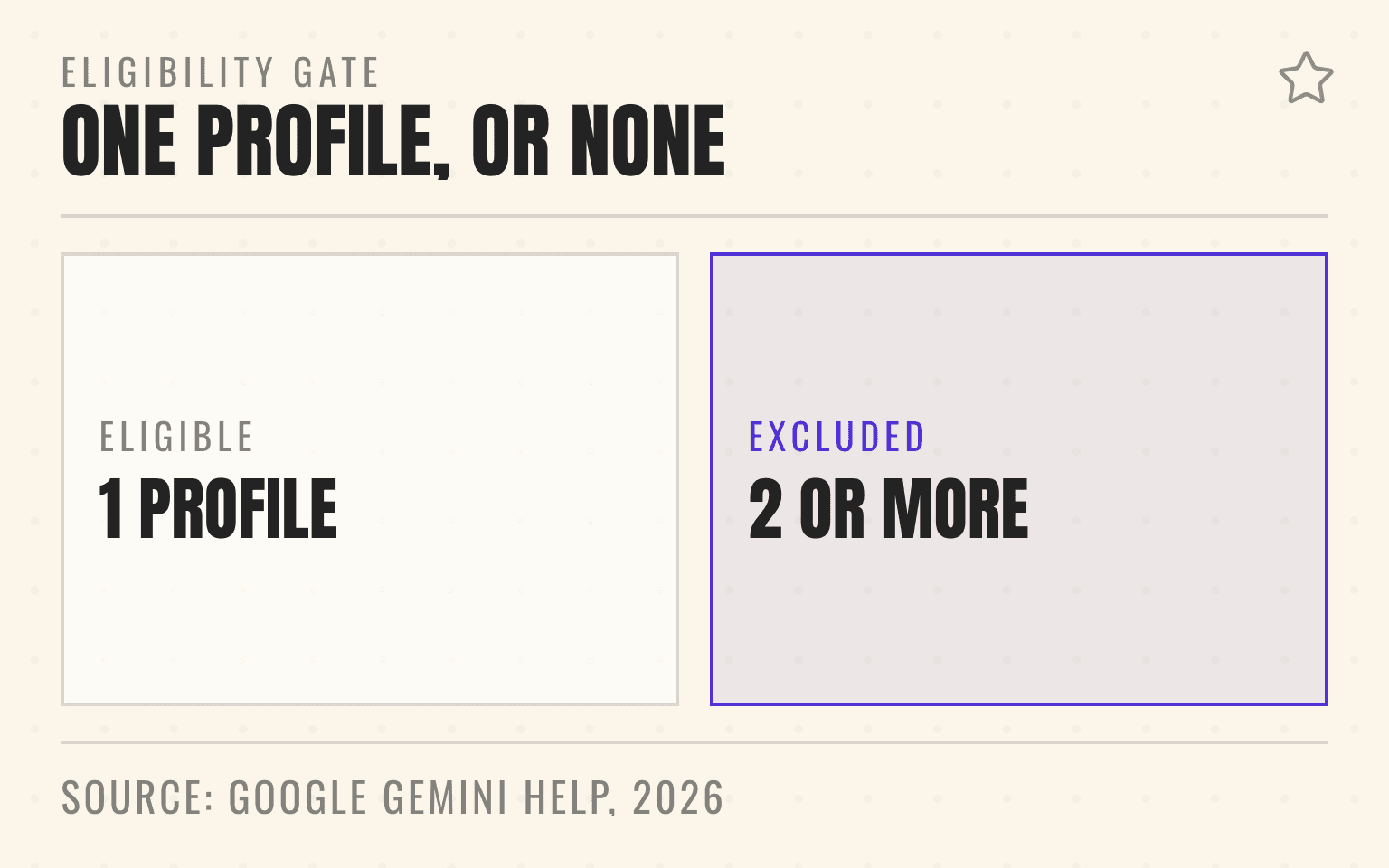
Google's Gemini help page rules out almost every multi-location operator in one line. The Business Profile connection is "Not available to owners or managers who have access to more than one verified Business Profile." That single sentence, checked September 2, 2026, is the whole story for a regional brand.
Last verified: September 2, 2026.
An 80-location restoration platform sees Google's June 10, 2026 announcement that Gemini can work with a Business Profile. The headline feature is attractive:
"Ask, 'help me respond to my latest review,' and it can draft a highly tailored response in your brand's voice, referencing the specific feedback the customer left."
The catch is the eligibility rule above. The connected workflow currently requires the user to be an owner or manager of only one verified Business Profile, and Google says the feature is rolling out gradually.
That makes Gemini useful for a controlled one-location test. It does not make the Gemini app a central reply desk for a regional brand, franchise system, or PE-backed portfolio with dozens of profiles.
Important
Gemini can draft a response. It cannot know whether the reviewer described the correct branch, whether a job record supports the claim, or which public details create a privacy problem.
If the wider review operation still depends on branch inboxes and spreadsheets, start with the Cheers review generation system. Drafting is one step inside a location-owned workflow.
What Gemini can do with a Business Profile
Google's Gemini help page says an eligible profile owner or manager can connect a Business Profile and then "ask Gemini questions about your Business Profile on Google or ask it to perform actions for you, like updating your business hours." On reviews specifically, the help page lists two capabilities: "Draft or delete replies to customer feedback" and "Get star ratings and customer reviews, including associated media." Google's June 2026 announcement gives a similar example: a business owner can ask for reviews without responses and have Gemini help draft replies.
This is a connected action, not a general writing prompt. Gemini can retrieve context from the connected profile and help operate on it. The access boundary matters because the resulting reply is public under the business's name.
Google describes the rollout as gradual and limits the current connection to a user managing one verified profile. A multi-location organization should therefore separate two questions: can one eligible location use the feature, and can the portfolio govern review responses at scale? The first may be yes. The second still needs its own queue, permissions, approvals, and evidence.
Do not remove legitimate owners, rearrange access, or create shadow accounts just to fit a feature gate. Use the Business Profile access guide for multiple locations to preserve accountable ownership while Google expands the connection.
The one-profile limit changes the rollout
A central reputation lead often manages 20 to 500 profiles. Regional managers may own market clusters. Local general managers need enough access to handle branch facts. That structure is designed for operational accountability, but it does not match Gemini's current one-profile requirement.
The safest pilot is a genuine single-profile operator inside the portfolio: one verified location, one accountable owner, and one review queue that can be audited. Choose a branch with steady review volume, a reliable manager, and few unresolved escalations. Avoid starting with the most controversial market simply because it has the largest backlog.
The pilot should answer a narrow question: does Gemini reduce drafting time without increasing factual edits, privacy corrections, or wrong-profile actions? It should not be framed as an enterprise deployment or a ranking test.
AI can draft, but the local operator decides
A review reply is easy to make fluent and hard to make locally true. Consider a pest control review that says the technician "sealed the attic entrance." The work order may show an exterior foundation gap instead. A generic reply that repeats the attic detail turns the customer's version into a company statement.
The reviewer may still be describing a genuine experience. The reply owner should verify the location, service date, service line, and safe public facts before correcting or confirming anything. If the mismatch cannot be resolved from approved records, the response can acknowledge the concern and move the conversation offline.
The negative-review response guide provides the service-recovery framework. Gemini can help phrase the opening, but responsibility stays with the person who understands the incident and owns the follow-up.
Give each review a risk lane
Route the review before drafting. A useful four-lane system is:
- Routine praise: thank the customer briefly when a response adds value; do not force a public reply to every rating.
- Factual question: verify the location's service, hours, coverage, or policy before answering.
- Service complaint: assign the incident owner, check the record, and provide a specific offline resolution path.
- Sensitive or regulated issue: escalate safety, legal, discrimination, clinical, insurance, employee, or personal-data claims before drafting.
Google tells businesses to keep responses useful, polite, and concise. It also says not every review needs a public thank-you. The goal is not a 100 percent response rate. The goal is a consistent decision that a future customer can understand.
This is where templated AI replies often fail. They optimize for visible activity. A good operating system optimizes for the right response, including the decision not to reply when the business has nothing useful to add.
Keep private job details out of public replies
Business Profile replies are public. Google Maps policy also restricts personal information posted without consent. The fact that a reviewer mentioned a diagnosis, home condition, insurance dispute, employee name, gate code, or account detail does not give the business permission to repeat it.
A med spa reply creates an obvious boundary. A reviewer may identify a treatment and describe an outcome. The clinic can acknowledge the feedback and offer a private follow-up without confirming whether the person was a patient, naming a provider, or discussing the treatment record.
The same rule applies in home services. A restoration company should not publish details about a loss, insurer, or occupied property merely to prove that its internal record is correct. A garage door operator should not expose a home's access or security condition. A careful reply protects the customer even when the original review did not.
Google's Gemini Apps Privacy Hub explains that connected apps can share relevant information with Gemini and that some Gemini Apps activity can be reviewed by human reviewers depending on settings. Teams should use approved accounts, keep unnecessary customer data out of prompts, and follow their own legal and data-handling requirements.
Next step
Is AI recommending your business?
Find out how visible you are across ChatGPT, Gemini, Perplexity, and AI Overviews.
Build one portfolio queue around the human decision
Gemini's connected experience may begin at one eligible profile, but the portfolio still needs a shared control record. For every review considered, capture:
- Profile and location owner, review link, rating, and received date
- Risk lane, service line, and the internal person assigned to verify facts
- Original AI draft, human edits, approval owner, and decision time
- Private details removed and any policy or specialist escalation
- Published reply URL or no-reply reason
- Public readback result, correction, deletion, or later customer update
Google's Business Profile APIs can list reviews for a location, retrieve reviews across multiple locations with batch methods, and publish or delete a reply for an approved integration. The multi-location reviews API workflow explains how to turn those methods into an approval and readback queue. Those capabilities do not eliminate the need for location-level authority.
If a vendor says it can automate the entire process, ask it to demonstrate identity mapping, draft history, reviewer roles, sensitive-review routing, API failure handling, and public readback. The home services review software guide provides the broader evaluation criteria.
Measure editing and exceptions, not reply volume
Response count is a weak success metric. A branch can publish 200 generic replies and learn nothing about service recovery or customer trust.
Coverage is also, for most brands, already solved. In the Cheers production review pull covering the 90 days ending September 2, 2026, the owner response rate across 73 home-services organizations was 81.9%, while the median organization collected only 6.0 new reviews a month. Drafting speed is not the constraint at that volume; verification is. Aggregate only, no organization named; see the panel methodology and the Home Services AI Visibility Index.
Track time to first draft, time to approved decision, percentage of drafts requiring factual edits, privacy edits, escalations, wrong-profile attempts, rejected publications, and public readback failures. For complaints, also track whether the named incident owner made contact and whether the underlying operating issue was closed.
Compare the pilot with the same branch's prior manual process. If Gemini saves three minutes on routine praise but creates more corrections on complaints, keep it in the low-risk lane. If managers copy the output without checking records, stop the pilot and repair the approval step.
Do not call ranking movement a reply win. Google says review count and positive ratings can help local ranking, but it does not document an individual business reply as a direct ranking factor. Review operations, local search performance, and review-derived content should be measured as related but separate systems.
Run a 14-day one-location pilot
During the first three days, confirm that the chosen owner is genuinely eligible, preserve the existing access model, and classify two weeks of recent reviews into the four risk lanes. Record the current response process and correction rate before Gemini enters the workflow.
From days four through seven, use Gemini for drafts only. Do not publish from the first draft. Have the local manager compare each sentence with the review, job record, public profile, and privacy boundary. Save the edits and no-reply decisions.
From days eight through fourteen, allow approved low-risk replies to publish through the connected workflow. Keep complaints and sensitive reviews in the existing escalation path. Read every published reply back on the correct profile, then compare drafting time, edit rate, and exceptions with the baseline.
At the end, decide by lane. A useful result may be narrower than the launch announcement: Gemini drafts routine replies for one eligible profile while the portfolio retains its established queue for everything else. That is still a real improvement if the facts stay accurate and the local owner remains accountable.
The immediate next step is simple. Pick one eligible location, assign one reply owner, and audit the last 20 reviews before connecting anything. The backlog will show whether the real constraint is writing speed or operational verification.
Sources
- Manage your Business Profile on Google with the Gemini web app. Google Gemini Help, undated help page. Capabilities, gradual rollout, and the one-verified-profile eligibility limit. Checked September 2, 2026.
- New Gemini features for businesses. Google, June 10, 2026. The Business Profile connection and review reply drafting. Checked September 2, 2026.
- Manage customer reviews. Google Business Profile Help, undated help page. Checked September 2, 2026.
- Prohibited and restricted content. Google Maps contribution policy, undated policy page. Personal information and prohibited content boundaries. Checked September 2, 2026.
- Work with review data. Google Business Profile APIs, last updated August 28, 2026. Checked September 2, 2026.
- Gemini Apps Privacy Hub. Google Gemini Help, undated help page. Connected-app data use, activity controls, and human-review disclosures. Checked September 2, 2026.
- Add and remove Business Profile owners and managers. Google Business Profile Help, undated help page. Checked September 2, 2026.
- Home Services AI Visibility Index 2026. Cheers Research, September 2, 2026.
Amadeus Peterson is the CTO and Co-Founder of Cheers, the local search platform for service businesses.