

Microsoft relaunched Bing Places for Business on October 3, 2025, and was careful about what the import actually promises: "The new import flow is faster, more reliable, and better at preserving key attributes like business name, hours, and contact details." Preserving attributes is not the same as approving them. Nothing in that sentence says the branch should exist, that the phone reaches the right team, or that the website still belongs to your company.
Which is how this goes wrong. A 75-location HVAC group imports its Google listings on Friday; by Monday, operations has found a former branch, two crossed phone routes, and one acquired company still pointing at its old domain. The import worked. The rollout did not.
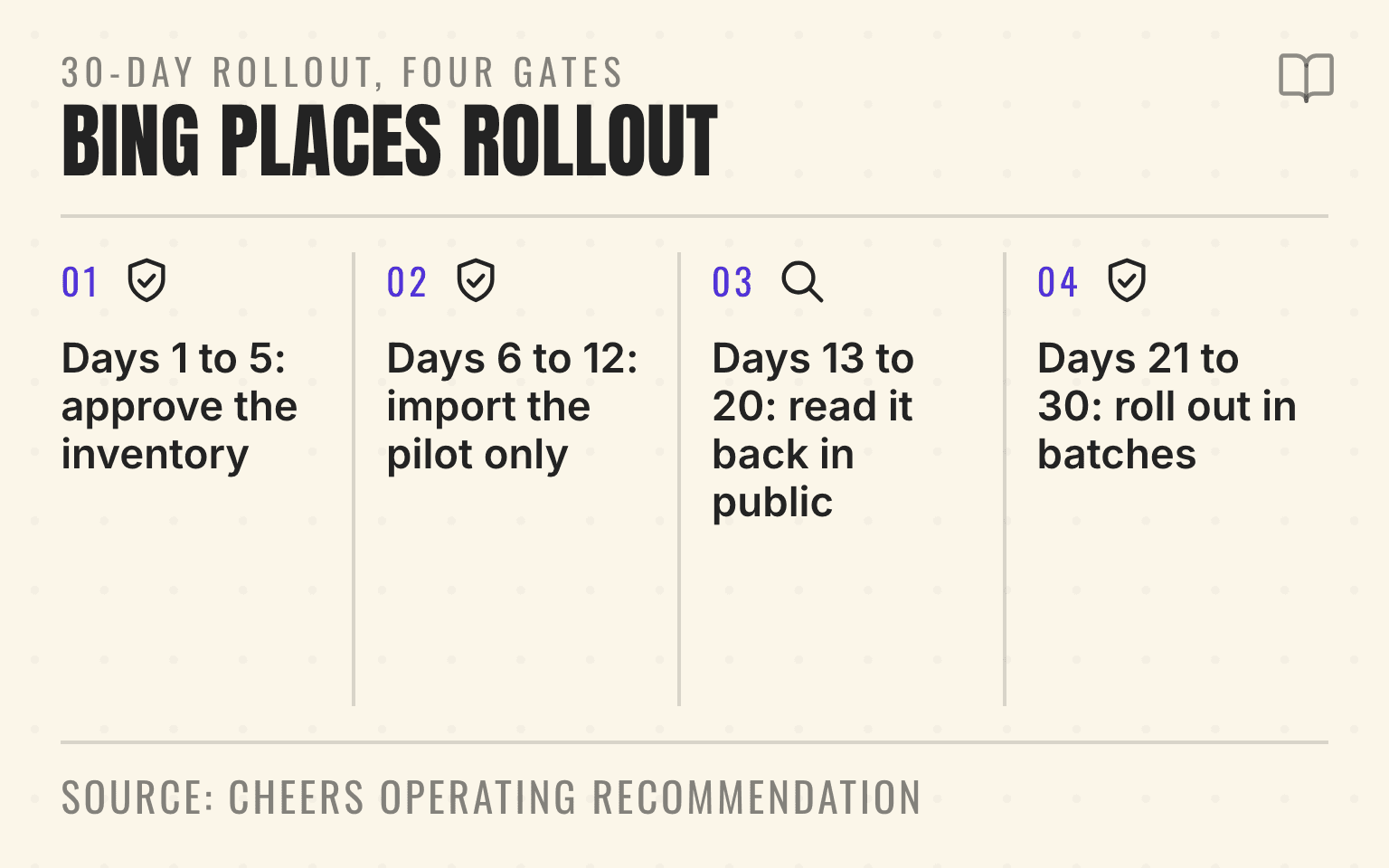
30-day rollout, four gates
Import is not approval
- 01Ops
Days 1 to 5: approve the inventory
Canonical record per branch, pilot selected, access confirmed, before-state URLs saved
- 02Listings
Days 6 to 12: import the pilot only
Compare every field, resolve warnings and duplicates, verify phone and website destinations
- 03Verify
Days 13 to 20: read it back in public
Bing Search and Bing Maps from the market served, on mobile and desktop
- 04Scale
Days 21 to 30: roll out in batches
Verify each batch, assign recurring ownership, schedule the first exception audit
Cheers operating recommendation, built on Microsoft's documented Bing Places scope (Microsoft Bing Blogs, October 3, 2025; Microsoft Support, checked September 2026). Microsoft does not publish a rollout timeline.
- Flow diagram of a four-gate 30-day Bing Places rollout for a multi-location brand.
- 1. Days 1 to 5: approve the inventory: Canonical record per branch, pilot selected, access confirmed, before-state URLs saved
- 2. Days 6 to 12: import the pilot only: Compare every field, resolve warnings and duplicates, verify phone and website destinations
- 3. Days 13 to 20: read it back in public: Bing Search and Bing Maps from the market served, on mobile and desktop
- 4. Days 21 to 30: roll out in batches: Verify each batch, assign recurring ownership, schedule the first exception audit
For a multi-location service brand, Bing Places belongs in the same operating system as Google Business Profile, Apple Business, location pages, call routing, and the citation cleanup queue. If leadership cannot see which public sources disagree with the approved branch record, check the brand's location-level visibility before expanding the import. Start with a controlled pilot, approve the location facts, inspect warnings and duplicates, and read the result back in Bing Search and Bing Maps.
Important
Microsoft framed Copilot work as forward-looking, not shipped: "We are continuing to invest in features that make Bing Places for Business more powerful and accessible, from deeper integrations with Bing Maps and Copilot to expanded support for agencies and other partners." Do not promise that a listing controls a Copilot recommendation. Manage Bing Places for accurate Bing Search and Maps facts, then measure AI answers separately.
Know what the new Bing Places can do
Microsoft's relaunch announcement describes what changed for portfolio work: "Once imported, managing listings is easier than ever, with intuitive dashboards, bulk editing tools, and real-time status updates."
Microsoft Support sets the boundary of the tool in one line: "To add or change information about your business in Bing Maps search results, use Bing Places for Business to claim or update your business listing." Bing Places is the management surface for Bing Search and Maps facts. That is its documented job.
That is the documented scope: a business-listing management surface for Bing Search and Maps. It is useful even if an AI recommendation never changes. Customers get a better chance of reaching the right branch, local teams inherit fewer routing errors, and the central office has another public source it can verify.
The portal does not replace a location database. It also does not resolve whether a franchise, acquisition, service-area business, or closed branch should exist. Those are operating decisions the brand has to settle before import.
Freeze one canonical record per location
Do not start with every listing Google happens to contain. Start with the branches the company is prepared to operate publicly.
Create one approved record for each location, tied to an internal store code that will survive a rebrand or platform change. At minimum, capture:
- Identity: operating status, approved public name, parent brand, legitimate former name, and the person accountable for the branch
- Customer route: current address or service-area configuration, working phone path, dedicated location URL, regular hours, and temporary exceptions
- Service truth: services actually sold in that market, business type, customer-facing categories, and any eligibility constraint that changes how the address should appear
- Publishing control: current Bing state, verification owner, duplicate or suppression note, last edit, last public readback, and the next review date
An HVAC rollup should not import a warehouse just because the location exists in a spreadsheet. A med-spa group should not attach a shared call-center number if it cannot route the caller to the selected clinic. A restoration platform should not keep an acquired company's old domain after the customer journey has moved.
This is the same identity problem covered in How to Fix Conflicting Records Across 50 Locations. The canonical record lets the team distinguish a harmless formatting difference from a former address, disconnected number, duplicate branch, or wrong market.
Pilot the Google import before the portfolio
Choose five to ten locations that represent the hard cases in the portfolio. Include a normal storefront, a service-area branch, an acquisition or rebrand, a location with a recent move, and one market with a known duplicate. The sample should expose the process, not flatter it.
Use the new Google import only for the approved pilot locations. Record which account supplied the data, which locations were selected, when the import ran, and which fields Bing accepted or flagged. Do not assume the portal copied every Google field or preserved the intended branch relationship.
Then compare every imported listing with the canonical record. The useful questions are concrete. Did the phone reach the promised team? Did the URL land on the right location page? Were normal and holiday hours still current? Did a former brand or former address reappear? Was a location that should hide its address published differently?
Microsoft says some business types may hide their address, but a valid address is still required in the management flow. Do not copy Google eligibility assumptions into Bing without checking the current portal behavior for the actual business type.
Pro Tip
Import is a transfer mechanism, not an approval. A branch is complete only after the team verifies the managed record and the public customer experience.
Resolve warnings, duplicates, and lifecycle exceptions
Real portfolios rarely arrive clean. Acquisitions create former names. Moves leave old addresses. Franchise transfers divide access. Closures remain visible after the phone and location page disappear.
Give each exception one owner and one resolution state. A suspected duplicate should show both public URLs, the canonical branch it may represent, and the action requested. A moved branch should preserve the continuing identity while the old address is removed from customer routes. A closed branch should move through a documented closure process rather than vanish from the central record.
For a 120-location plumbing platform, this prevents corporate marketing from editing the current branch while a regional manager tries to reclaim the former listing. The work may happen in Bing Places, but the decision belongs in the shared operating ledger.
Use the closed-location cleanup workflow for branches that no longer serve customers. For acquisitions and moved locations, preserve the internal store code, public transition notes, and approved destination so the wrong record does not return during the next import.
Next step
Is AI recommending your business?
Find out how visible you are across ChatGPT, Gemini, Perplexity, and AI Overviews.
Read the listing back like a customer
A green status inside a management portal is not the public result.
After Bing accepts or verifies a pilot listing, search the brand and service in the location it serves. Open the Bing Maps result. Check the displayed name, address or service-area treatment, phone, hours, website, services, and photos. Follow the phone and website routes instead of stopping at the listing card.
Microsoft is explicit that the device changes the answer: "When you search on Bing it can use the location of your device to better respond to your search queries and to provide you with relevant information, such as the closest coffee shops." A result observed from headquarters may not represent what a customer sees near the branch, so record the market you tested from.
Run the same readback on mobile and desktop when the customer path differs. Call the number during both staffed and after-hours windows. Test any redirected location URL. Save the public URL, observed result, market, device, and timestamp in the branch record.
For a med-spa group, the decisive failure may be a phone route that sends a prospective patient to the wrong clinic. For a garage-door franchise, it may be a regional landing page that cannot confirm the customer's ZIP code. Those failures are more important than whether two platforms abbreviate the street in the same way.
Put Bing Places inside normal change control
The portfolio will drift again unless Bing has an owner after launch. Location operations should trigger updates for openings, moves, closures, rebrands, phone changes, holiday hours, service changes, and agency transitions. The listings team should publish only the approved facts and record the public readback.
Set the cadence by operational risk. A fast-growing rollup may review change events weekly and sample stable locations monthly. A mature franchise may use a monthly exception queue and a quarterly portfolio audit. Microsoft does not prescribe those cadences; they are operating controls.
The platform owner also needs durable access. Avoid making a departing employee or agency the only person who understands the portfolio. Record the Microsoft account or approved access path, backup owner, import source, verification dependencies, and escalation history.
Keep Google, Apple, Bing, and owned location pages in one change manifest, but verify them independently. The Apple Business guide for multi-location brands uses the same principle: shared brand control does not remove the need to validate each physical location and customer handoff.
Keep the AI expectation honest
Bing Places is worth doing for Bing Search and Maps customers. It is not a lever on the AI answers most home-services buyers currently see. In the Cheers Market Baseline for the 28 days ending September 2, 2026, 32 home-services buyer prompts ran in 100 metro service areas across ChatGPT, Gemini, Perplexity, and Google's AI Overviews and AI Mode, producing 356,019 classified citations. Of the 23 platform and directory domains cited in 33 or more of those metros, none was a Microsoft property.
That is a statement about what those four engines cited in that window, not a prediction about Copilot, which was not in the panel. Read it as a scoping fact: fix Bing Places because customers use Bing Maps and because a wrong phone number is a wrong phone number everywhere, then measure AI answers on their own terms. The cuts are documented in the Cheers Research methodology and the Home Services AI Visibility Index 2026.
Use a 30-day rollout with explicit gates
The following sequence is a Cheers operating recommendation, not a Microsoft processing timeline:
- Days 1 through 5: approve the canonical location inventory, choose the pilot, confirm access, preserve before-state URLs, and record lifecycle exceptions
- Days 6 through 12: import only the pilot, compare every field, resolve warnings and duplicates, and verify the phone and website destinations
- Days 13 through 20: read the pilot publicly in Bing Search and Maps, document failures, fix the process, then approve the remaining location groups
- Days 21 through 30: roll out in controlled batches, verify each batch, assign recurring ownership, and schedule the first exception audit
The rollout is complete when leadership can answer six questions for every branch: should it exist, who owns it, which source supplied it, what exceptions remain, what a customer sees now, and when it will be checked again.
Sources
Every link below was opened and checked September 2, 2026.
- Introducing the New Bing Places for Business. Microsoft Bing Blogs, October 3, 2025. Source of the three quoted passages: the import flow, the dashboard and bulk editing tools, and the forward-looking Bing Maps and Copilot wording.
- Add and manage your business listing. Microsoft Support, checked September 2026. Source of the quoted instruction to use Bing Places to claim or update a listing shown in Bing Maps.
- How Bing uses your location. Microsoft Support, checked September 2026. Source of the quoted device-location behavior behind local results.
- Cheers Research methodology and the Home Services AI Visibility Index 2026. Cheers Market Baseline, 28 days ending September 2, 2026: 32 home-services prompts in 100 metro service areas across four engines, 356,019 classified citations, aggregate only. Source of the cited-platform finding above.
The article previously linked the bing.com/forbusiness landing page for the bulk-upload claim. That page renders its content in the browser and returned nothing verifiable on September 2, 2026, so the claim was narrowed to the bulk editing tools Microsoft describes in the relaunch post.
Amadeus Peterson is the CTO & Co-Founder of Cheers, the local search platform for multi-location service businesses.