

Two sentences from Google set the ceiling on what this work can buy you. The LocalBusiness documentation, last updated December 10, 2025, says: "Google does not guarantee that features that consume structured data will show up in search results." Its guide to generative AI features, updated July 10, 2026, goes further: "Structured data isn't required for generative AI search, and there's no special schema.org markup you need to add."
So this is not a ranking play. It is a records problem. A 100-location service brand does not have one local identity; it has a parent brand, distinct branches, local phone routes, different hours, separate service coverage, and sometimes different operators behind the same public name. Copying one LocalBusiness block across the whole website flattens all of that, putting every branch into one homepage script creates a maintenance burden, and letting each franchisee invent its own markup creates a worse one. Google's starting rule is to define each local business location as a LocalBusiness type using the most specific accurate subtype, on the page that describes it.
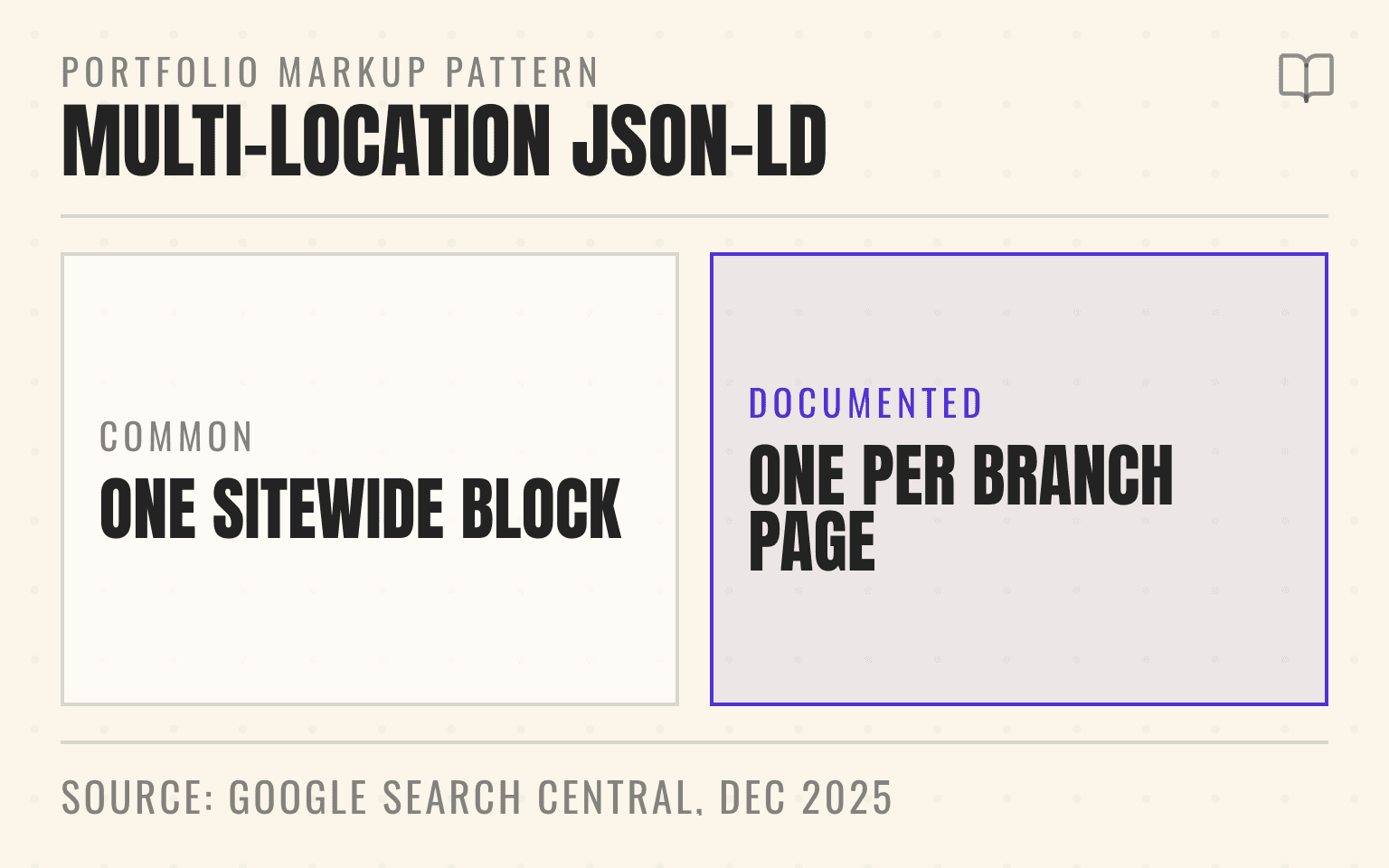
Portfolio markup pattern
One block or one branch
What most templates ship
One sitewide block
- Same entity repeated on every page
- Every branch in one homepage script
- Corporate phone and hours everywhere
- A closure leaves the old address in the layout
What Google documents
One entity per branch page
- LocalBusiness on the page it describes
- Most specific accurate subtype per branch
- Stable @id, parentOrganization to the brand
- Fields generated from one approved record
Google Search Central: Local business structured data and General structured data guidelines (developers.google.com/search/docs/appearance/structured-data), last updated December 2025.
Important
Treat LocalBusiness schema as a machine-readable branch record. One real location should map to one stable entity whose page, phone, hours, address, services, and public profiles agree.
Start with one entity per real location
For a multi-location HVAC, plumbing, electrical, roofing, pest-control, restoration, med-spa, or franchise brand, the operating default is one canonical page for each real branch and one LocalBusiness entity that describes that branch.
Google does not say a location page must use one exact URL pattern. It does say each location should be defined as a LocalBusiness and that the fully qualified URL should point to the specific business location. Its general guidelines say structured data belongs on the page it describes.
That makes the branch page the cleanest home for branch markup. The Phoenix HVAC page can carry the Phoenix phone number, hours, address or customer-safe service-area facts, local URL, and real service proof. The Columbus med-spa page can carry the clinic's address, hours, phone, and accurate subtype. A restoration roll-up can keep a staffed storefront branch separate from a service-area operation that does not receive customers.
This is a page-governance problem before it is a code problem. The location page checklist covers the visible content each branch needs. A multi-location local SEO system should keep those pages, profiles, and approved location facts aligned before a template emits JSON-LD.
Separate the parent brand from each branch
The parent brand and the branch are related, but they are not the same entity.
Use Organization schema on the corporate homepage to describe the parent brand. Use LocalBusiness, or the most specific accurate subtype, on each branch page. Schema.org provides parentOrganization to connect a branch to the larger organization. W3C's JSON-LD specification defines @id as the identifier for a node, which lets the same branch be referenced consistently by other entities.
A stable @id is an engineering convention, not a Google ranking field. Use a durable canonical URL plus a fragment, and keep it stable when copy or templates change. Do not reuse one branch @id for another location after a closure or acquisition.
A shortened fictional example looks like this:
{
  "@context": "https://schema.org",
  "@type": ["Electrician", "Plumber"],
  "@id": "https://example.com/locations/phoenix#location",
  "name": "Example Home Services",
  "url": "https://example.com/locations/phoenix",
  "telephone": "+1-602-555-0100",
  "address": {
    "@type": "PostalAddress",
    "streetAddress": "1000 Example Avenue",
    "addressLocality": "Phoenix",
    "addressRegion": "AZ",
    "postalCode": "85001",
    "addressCountry": "US"
  },
  "parentOrganization": {
    "@type": "Organization",
    "@id": "https://example.com/#organization",
    "name": "Example Home Services"
  }
}
The example is deliberately small. Add a field only when the visible page and operating source can keep it accurate.
Build the markup from facts customers can verify
Google requires name and address for LocalBusiness rich result eligibility. It recommends other location-specific properties such as telephone, URL, geographic coordinates, and opening hours. Google also says the URL should be a working link for the specific business location.
Those fields should come from the same approved location record that feeds the page. A CMS should not store one phone number in visible copy and a different number in JSON-LD. A holiday-hours update should not change Google Business Profile while leaving the page and markup on the regular schedule. A branch closure should not leave the old address embedded in a global layout.
For service-area businesses, do not publish a hidden residential or warehouse address solely to complete a markup template. Google Business Profile is unambiguous: "If you don't serve customers at your business address, remove your address from your Business Profile." Google's structured data policy separately requires markup to be a true representation of visible page content. Customer safety and truthful representation come before rich result eligibility, every time.
Service details need the same discipline. LocalBusiness identifies the branch. Service can describe an offering and point back to that provider when the page supports the relationship. The Service schema guide explains how to connect those entities without turning a service list into a ranking claim.
Keep Business Profile and schema in their proper roles
Google Business Profile and LocalBusiness schema are separate control surfaces.
Business Profile manages customer-facing information on Google Search and Maps. Structured data gives Google and other parsers explicit clues about a web page. A correct JSON-LD block does not overwrite a wrong profile, and a verified profile does not repair stale markup.
Google's Business Profile guidelines say a phone number should connect to the individual location and the website should represent that location. That is the reconciliation target. The branch page, its LocalBusiness record, and its Business Profile should lead a customer to the same local operation.
Use sameAs only for public URLs that identify the exact entity on the page. Parent-brand social profiles belong with the parent Organization. Branch profiles belong with the matching LocalBusiness. The sameAs implementation guide covers that narrower identity relationship.
Do not turn JSON-LD into a location database
A schema graph should describe the page, not expose the entire internal operating system.
- Do not copy the same LocalBusiness entity across every service and blog page on the site.
- Do not put hundreds of unrelated branches into one global script simply because the CMS can.
- Do not publish private addresses, internal IDs, direct employee data, or unapproved acquisition records.
- Do not add services, hours, credentials, or service areas that customers cannot verify on the page.
- Do not import Google, Yelp, or other third-party ratings into self-serving AggregateRating markup. Google says LocalBusiness and Organization pages controlled by the reviewed entity are ineligible for review stars.
- Do not treat a passing validator as proof that the branch is eligible, indexed, prominent, or recommended.
Google's structured data guidance is explicit on the core risk. Markup can be syntactically correct and still fail quality policies because it is stale, hidden, irrelevant, or misleading.
Next step
Is AI recommending your business?
Find out how visible you are across ChatGPT, Gemini, Perplexity, and AI Overviews.
Model franchises, acquisitions, and departments truthfully
Multi-location ownership structures often change faster than the website template.
A franchise branch can share a public brand while being operated by a separate franchisee. An acquired HVAC company may keep its customer-facing name during a transition. A med-spa group may have individual practitioners, but the clinic is still the location customers book. Schema should mirror what the page and public business structure actually say. It should not invent a parent relationship, hide a franchise operator, or merge a practitioner with a clinic.
Schema.org's parentOrganization property can describe the larger organization a branch belongs to. Use it when that relationship is accurate and visible. For an acquired brand that has not yet moved under the parent publicly, forcing the new parent into every branch record can get ahead of the customer experience.
Google also supports department markup for a real department with distinct properties such as hours or telephone. Do not use department as a container for service lines that are only categories on a page. A department should be a real public-facing unit that a customer can identify and contact.
Roll out the pattern across 20 to 500 locations
The first valid example is not the difficult part. Change control is.
- Create one approved location data contract for public name, canonical URL, customer-safe address, phone, hours, subtype, parent, profile URLs, and status.
- Generate visible page facts and JSON-LD from the same approved record when the publishing system allows it.
- Pilot one storefront, one service-area business, one franchise or acquired location, and one exception before widening the release.
- Add automated checks for unique @ids, canonical URLs, required fields, invalid types, private-address leakage, and duplicate branch records.
- Require a human public readback for phone routing, hours, address, page content, profile destination, and customer action.
- Re-run the checks when a branch opens, closes, moves, rebrands, changes phone routing, adds a service, or changes ownership.
The portfolio owner should be able to answer three questions for every field: where the value comes from, who approves it, and what event makes it stale. If the team cannot answer those questions, adding the field increases maintenance risk.
Validate syntax, eligibility, and source agreement
Test the vocabulary
Use the Schema.org Validator to inspect types, properties, and graph relationships. This catches vocabulary mistakes, disconnected nodes, and malformed values that a page template can repeat at scale.
Test Google eligibility
Use Google's Rich Results Test to see which Google-supported structured data the page exposes. A clean result means the parser can read the markup. It does not guarantee a rich result. After deployment, use URL Inspection in Search Console to confirm that Google can access the rendered page.
Test the operating truth
Compare the live page, rendered JSON-LD, Business Profile, location finder, phone route, and booking destination. This is the test most validators cannot perform. A valid Phoenix branch entity is still wrong if the phone reaches Tucson or the hours belong to the corporate office.
Google's AI Search guidance adds the boundary again, in its own words: "Structured data isn't required for generative AI search, and there's no special schema.org markup you need to add." What does carry weight is the page itself. In the Cheers Market Baseline for the 28 days ending September 2, 2026, 68.1% of the 356,019 classified home-services citations pointed at contractor and franchise websites rather than directories, Google surfaces, or social sources. Keep using structured data as part of normal Search work, keep the page accurate because that is what gets cited, and measure AI visibility, citations, traffic, and booked demand separately. Method is in the Cheers Research methodology.
Use the first 30 days to prove the system
In week one, freeze the field definitions and identify the source of truth for each one. In week two, ship a small group that includes normal branches and exceptions. In week three, validate the deployed pages and reconcile them against public profiles. In week four, fix the template or data contract before expanding.
The rollout is ready when a location change can move from operations to the page, markup, profile, and customer path without a separate spreadsheet rescue. That is the real value of multi-location structured data: a branch record that remains accurate when the portfolio changes.
Sources
Every link below was opened and checked September 2, 2026.
- Local business (LocalBusiness) structured data. Google Search Central, last updated December 2025. Source of the quoted no-guarantee statement, the one-location-per-LocalBusiness rule, the specific-subtype recommendation, the supported properties, and department markup.
- General structured data guidelines. Google Search Central, checked September 2026. Source of the requirement that markup represent visible, current, relevant page content and sit on the page it describes.
- Optimizing your website for generative AI features on Google Search. Google Search Central, last updated July 2026. Source of the quoted statement that structured data is not required for generative AI search.
- Guidelines for representing your business on Google. Google Business Profile Help, checked September 2026. Source of the individual-location phone and website rules, chains, departments, and practitioners.
- Manage your service areas. Google Business Profile Help, checked September 2026. Source of the quoted rule on removing an address you do not serve customers at.
- LocalBusiness and Organization. Schema.org vocabulary, checked September 2026. Source of the branch definition and of the parentOrganization and subOrganization relationships.
- JSON-LD 1.1, node identifiers. W3C Recommendation, July 2020. Source of the definition of @id as a node identifier: in JSON-LD, a node is identified using the @id keyword.
- Cheers Research methodology. Cheers Market Baseline, 28 days ending September 2, 2026, 356,019 classified citations, aggregate only. Source of the 68.1% business-website citation share quoted above.
Amadeus Peterson is the CTO & Co-Founder of Cheers, the local search platform for multi-location service businesses.