


Review every AI-assisted page manually, including the four metadata fields Google names: titles, descriptions, structured data and image alt text. Google's generative AI content guidance, last updated October 1, 2026, makes that review part of the work before publishing. For a service brand with several locations, the practical question is who can verify that each branch actually offers what its page promises.
I would start with the page that can send a customer to the wrong service or the wrong location. A polished paragraph about same-day availability can cause more trouble than an awkward sentence when the branch cannot deliver it. Check the operating claim first, then the writing.
Last verified: October 19, 2026.
What the current guidance asks you to check
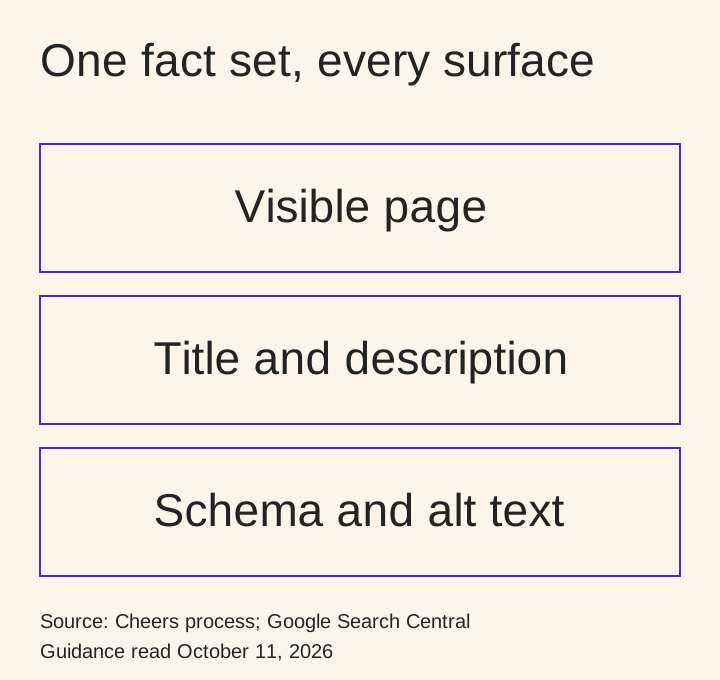
Google's current guidance calls for manual fact-checking and review of AI-generated content before publication. It extends that work to the title, description, structured data and alt text. Those fields can repeat an unsupported promise even after an editor removes it from the body. If a garage-door branch cannot promise same-day repairs, replacing that sentence with its actual scheduling policy is only part of the fix: remove the same-day promise from the search title and service description in structured data too.
The page also points readers to two sections of the Search Quality Raters guidelines: 4.6.5 on scaled content abuse and 4.6.6 on main content with little effort, originality or added value. Google explicitly says those ratings do not directly influence rankings. Treat the criteria as a way to examine the page, without turning them into a formula for getting to the top of Search.
For your own review, keep two questions separate. Is the information correct for this branch today? Does the page help a customer make a decision that the rest of your site leaves unanswered? A page can pass the first test and still repeat the same answer across a hundred URLs.
Give each operating claim an owner
Before asking an editor to improve a draft, collect the facts the editor can check. The branch manager can confirm service coverage and appointment handling. The person responsible for the offer can confirm its terms. The website owner can confirm that the contact button reaches the correct place. Assign the claim to the person who knows it, then keep the answer with the draft.
Consider an illustrative garage-door service page that says a branch replaces every spring type on the first visit. That sentence needs support from the branch's actual service scope and parts process. The reviewer should ask what happens when the required part is unavailable. The answer may produce a more useful explanation of inspection, ordering and scheduling. It should not produce a broader promise because broader copy sounds more persuasive.
Keep unresolved facts out of the customer-facing version until an owner answers them. An AI draft cannot establish a service area, a response time or a technician's qualification. An old page cannot establish that those facts are still current either. Record when the source was checked so the next editor knows what needs another look.
Our guide to what location pages should include covers the branch information this review should protect. Use that information as the starting point for the article, FAQ and search metadata.
Next step
Is AI recommending your business?
Find out how visible you are across ChatGPT, Gemini, Perplexity, and AI Overviews.
Require a useful reason for the page to exist
Google's spam policies describe scaled content abuse as generating many pages mainly to manipulate rankings rather than help users. The policy applies regardless of how the content was made. A human edit at the end does not, by itself, give a city-swapped page a useful purpose.
Read the proposed page beside its nearest existing owner. If both answer the same customer question, improve the established page. A distinct page earns its place when it resolves something materially different: a service limitation, a preparation step, an equipment choice or a local operating detail customers need before booking.
Original value does not require a new statistic. It can come from an accurate explanation of what the branch checks, what customers should have ready, and what changes the next step. Gather that information from the people who do the work. Preserve their limits instead of smoothing every answer into the same generic assurance.
Google's people-first content guidance asks whether content adds original information and substantial value compared with other results. My practical test is whether a customer can make a better decision after reading this page. If the answer is unclear, another URL will not solve the problem. The city-page ownership guide explains when existing pages should carry the answer.
Review the version customers will actually see
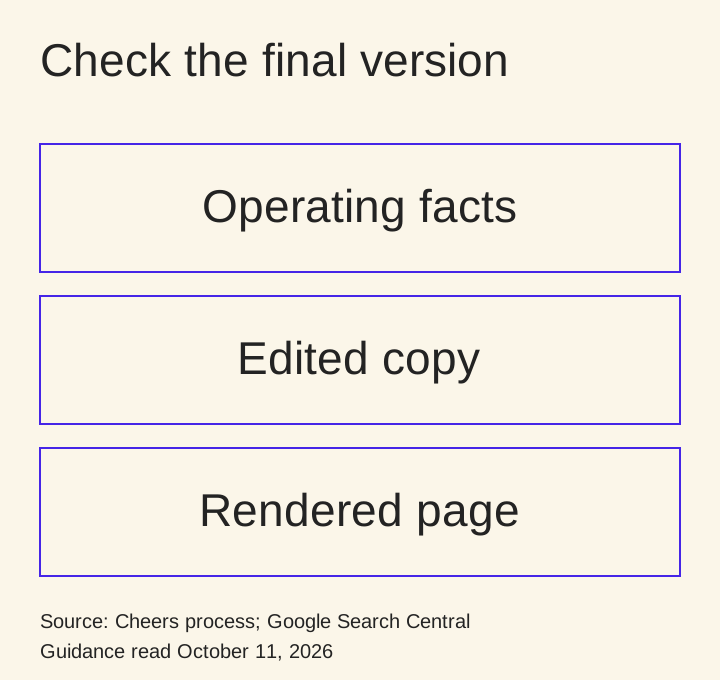
After the facts and purpose are sound, open the rendered page on a phone and a desktop. Read the title in the browser, the introduction, FAQs, image captions and conversion button. Check that an image caption describes what the image shows and that a fictional illustration is never presented as proof of a real job.
Compare the structured data with the visible page. The author, dates, business facts and FAQs should agree. A generated description can introduce a claim that the body never makes; a reusable schema template can keep an old date or the wrong identity. Inspect those outputs after the page is built.
Then follow the contact link through to its destination without submitting a test lead to a live business. Confirm the displayed location and the intended contact path. Review copy again if fixing the destination changes what the page can honestly promise.
Put one page through the process this week
Choose one service or location page whose claims matter to booking. Have the operating owner verify the services and limitations, ask an editor to remove unsupported statements, and have the website owner inspect the rendered page and metadata. Keep the source checks with the exact version they reviewed.
Use the result to improve the next brief. If the same fact is missing repeatedly, add it to the source material writers receive. If several pages serve the same question, resolve ownership before commissioning more copy. Track whether corrections survive the final build, rather than treating a completed draft as the end of the job.
The visibility grader can help you choose where to investigate next. It does not replace a branch owner's factual review. The useful outcome this week is a page your team can stand behind, with a clear reason for its existence and a contact path that works.
Sources
- Google Search's guidance on using generative AI content on your website. Google Search Central, updated October 1, 2026; read October 19, 2026. Supports manual review, the four named metadata fields and the distinction between rater feedback and direct ranking influence.
- Spam policies for Google web search. Google Search Central, read October 19, 2026. Supports the definition of scaled content abuse and its application regardless of production method.
- Creating helpful, reliable, people-first content. Google Search Central, read October 19, 2026. Supports reviewing originality and added value.
Dylan Allen-Arnegård is the CEO & Co-Founder of Cheers, the local search platform for multi-location service businesses.