

Since October 21, 2024, employee review programs have had a second rulebook. The FTC's Rule on the Use of Consumer Reviews and Testimonials covers insider reviews and incentives tied to sentiment, and it applies to a technician bonus plan the same way it applies to a marketing campaign. Google's policy was already the first rulebook.
Last verified: September 2, 2026.
Most businesses cannot connect a review to the service event, branch, or employee involved. Attribution can make customer feedback easier to investigate and use in coaching, as long as it does not become a rating quota or substitute for fair performance management.
If the team is still choosing the platform layer, start with Best Review Management Software for Home Services Companies before designing incentives. If the coaching loop needs an owner outside the branch, review generation is the managed version.
If you are still choosing the system that powers this coaching loop, start with Review Generation Software With Employee Attribution.
If you need the customer-facing workflow first, start with Review Collection at Point of Service: A Playbook. If you need the GEO reason attribution matters, read How Reviews Support AI Visibility for Local Businesses.
What attribution enables
When each review ties back to the employee who served that customer, you can:
Recognize specific service behaviors. Share verified customer feedback about clear communication, workmanship, punctuality, or service recovery.
Coach repeated issues. Connect recurring customer concerns with the relevant jobs and existing service-quality data before drawing conclusions.
Verify the process. Confirm that eligible customers receive the approved neutral review path without pressure or selective asking.
Recognize excellence. Celebrate measurable customer experience outcomes without creating pressure to chase review counts or specific ratings.
Improve training. Use repeated, verified themes to refine scripts, handoffs, scheduling, and technical coaching.
Important
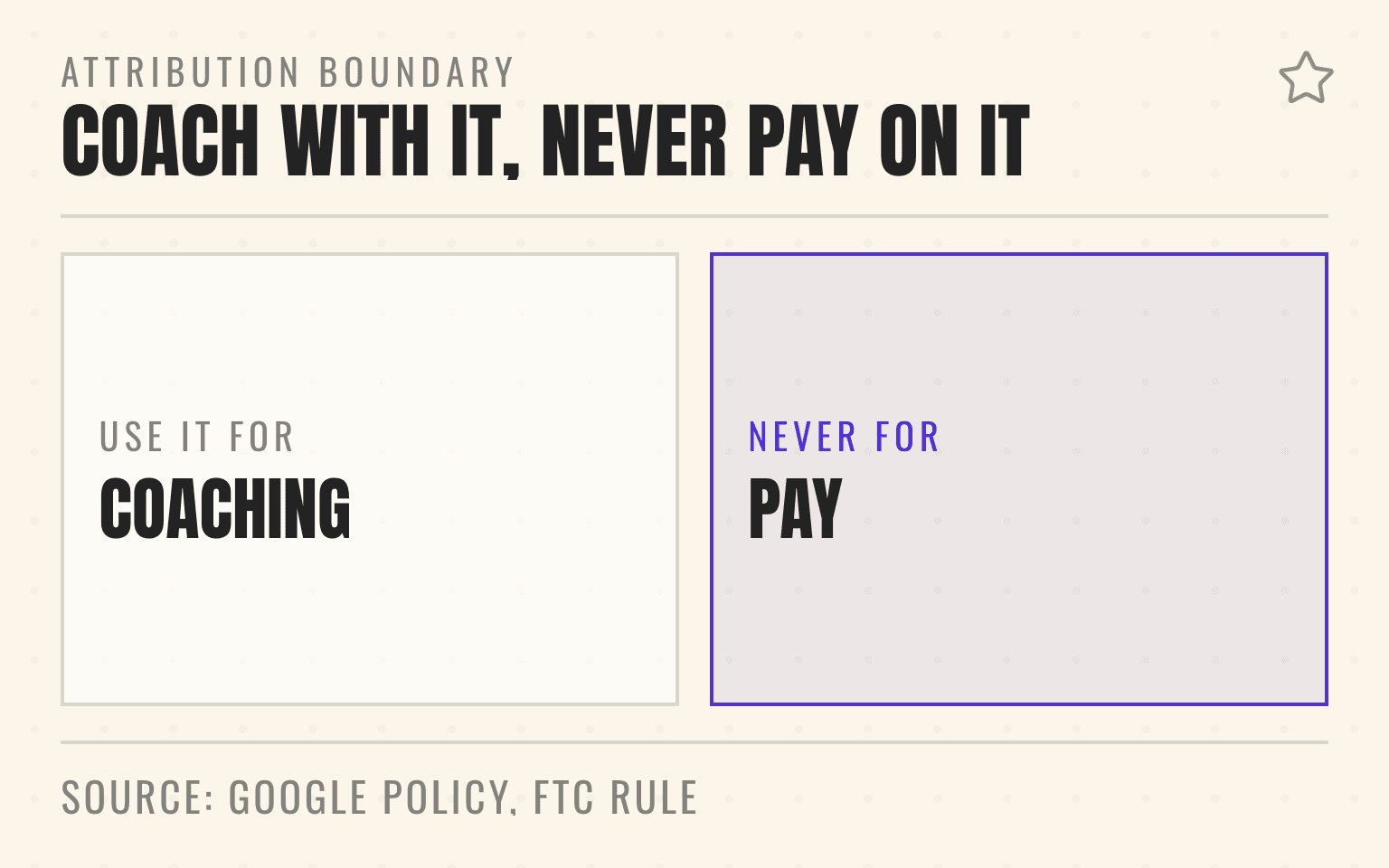
Attribution adds context. It does not prove that one employee caused a rating, and it should not be used alone for pay, discipline, promotion, or termination decisions.
Building a review culture
The goal is a service culture where employees understand how customer feedback relates to communication, workmanship, recovery, and the public reputation of each branch.
Make service themes visible. Share branch-level trends and specific positive feedback without ranking employees by review count, rating, or sentiment.
Celebrate the work. Recognize documented service behaviors, customer recovery, safety, teamwork, and process adherence rather than a review milestone.
Share feedback directly. When a customer mentions an employee by name in a positive review, show them. It's immediate validation.
Pro Tip
Address problems privately. If verified feedback and job evidence show a repeated issue, coach the behavior through the normal management process.
Recognition structures that stay compliant
Attribution is useful management data, but it should not create pressure on customers. Google allows businesses to ask for reviews, but it also warns against incentives, selective solicitation, requests for specific content, and staff programs that push a target number of reviews.
Keep review outcomes out of pay. Do not tie compensation to review count, rating, sentiment, or requested wording. These outcomes depend on customer choice and can create pressure or selective solicitation. The FTC's guidance draws the same line for incentives generally:
"It means that you can't suggest to consumers that their reviews must be positive (or negative) in order to obtain a promised incentive."
And when a staff member does review their own employer, the FTC's answer on disclosure is short: "Yes, but ask them to clearly and conspicuously disclose their relationship to your business."
Measure the process carefully. Review whether every eligible customer receives the approved neutral path, whether staff avoid rating language, and whether service recovery is documented. Process data should support coaching, not a per-review bonus.
Use established performance metrics. Base compensation decisions on lawful, job-related measures such as safety, quality, callback rate, first-time fix rate, complaint resolution, response time, and manager QA. Review content can provide context but should not determine pay.
Important
Do not punish employees for negative reviews or reward them for positive ones. Use one neutral eligibility rule for every customer and investigate service problems with broader job evidence.
Next step
Is AI recommending your business?
Find out how visible you are across ChatGPT, Gemini, Perplexity, and AI Overviews.
Coaching with review data
Reviews can provide useful coaching examples when the facts are verified and privacy is protected.
Repeated themes can suggest questions. If customers repeatedly mention that a technician explained the work clearly, identify the behavior and teach it. Absence of that phrase in another employee's reviews does not prove poor communication.
Specific reviews can trigger verification. "Technician was late" gives a manager a concrete question to check against dispatch and job records. A vague comment gives less evidence. Neither should be treated as a complete performance record by itself.
Review language can support coaching questions. Compare recurring, verified themes with operational data, manager observation, callbacks, and quality checks. Reviews are a selective sample of customer feedback, not a controlled employee evaluation.
Pro Tip
Respond appropriately to every serious complaint. For employment decisions, verify the facts and use broader, job-related evidence rather than treating one review or an unverified pattern as the conclusion.
What the panel says about the coaching load
Response coverage is usually not the constraint. In the Cheers production review pull covering the 90 days ending September 2, 2026, owners responded to 82.6% of reviews across 11 home-services companies, while the median company collected 9.7 new reviews per location a month and the 75th percentile company collected 26.4. Teams are replying to most of what they get; the wider gap is how much they get. Aggregate only, no company named, methodology here and full cuts in the Home Services AI Visibility Index.
That reframes the coaching conversation. Coach the handoff that creates the opportunity, not the rating the customer chose.
Implementation
Start with context. Connect reviews to jobs and branches, validate the facts, and share customer feedback through existing coaching routines.
Add recognition for specific service behaviors, teamwork, and recovery work. Keep customer ratings and review counts out of competitive rankings.
Be careful with incentives. If they create pressure to collect a target number of reviews, chase positive ratings, or ask for specific content, they belong outside the program.
Integrate with existing management. Customer feedback can inform regular one-on-ones, but formal performance and compensation decisions need broader, job-related evidence and appropriate HR review.
The operating standard
A responsible review program connects customer feedback to the job, branch, and service process without turning public ratings into an employee leaderboard.
Managers can use verified examples to recognize strong service behaviors, investigate specific failures, and improve the process. Formal performance and compensation decisions still require broader job-related evidence, appropriate HR review, and compliance with applicable law and policy.
Important
Attribution can provide context for coaching, but it does not make a customer review complete or unbiased evidence of employee performance.
Sources
- Prohibited and restricted content, including fake engagement and conflict of interest. Google Maps contribution policy, undated policy page. Checked September 2, 2026.
- Tips to get more reviews. Google Business Profile Help, undated help page. Checked September 2, 2026.
- Rule on the Use of Consumer Reviews and Testimonials: Questions and Answers. Federal Trade Commission, November 2024. Rule effective October 21, 2024. Checked September 2, 2026.
- Local Consumer Review Survey 2026. BrightLocal, 2026, 1,002 US adult consumers. Checked September 2, 2026.
- Home Services AI Visibility Index 2026. Cheers Research, September 2, 2026, corrected September 23, 2026.
Dylan Allen-Arnegård is the CEO of Cheers, the local search platform for service businesses.